
Canada NewsWire
New global survey of 815 enterprise CX leaders finds the leading approach across every major CX function is human agents assisted by AI, but most organizations lack the tools to assess and improve AI performance
VANCOUVER, BC, June 3, 2026 /CNW/ – New research commissioned by TELUS Digital and conducted by global consultancy firm, Ryan Strategic Advisory, reveals that across every major customer-facing function, from onboarding and technical support to billing and complaints, the majority of enterprises now rely on human agents assisted by AI. However, only 32% of enterprises surveyed currently use AI-powered quality assurance (QA) and coaching tools, meaning the majority of organizations adopting AI-assisted customer experience (CX) do not have the automated infrastructure in place to effectively monitor AI performance and feed insights back into ongoing improvement. This loop can help give organizations the visibility to connect AI investment to the customer and business outcomes they want to drive.
TELUS Digital, a global technology service provider specializing in AI-powered digital customer experiences (CX) and future-focused digital transformations, today released the full findings in the report Enterprise CX AI: 2026 Global Survey, an international study of 815 enterprise CX decision-makers from organizations that operate contact centers. The survey was conducted in Q1 2026 across 12 countries and 19 industry verticals spanning financial services, telecommunications, healthcare, retail and technology.
Respondents were asked a number of questions in the survey, including “Which best describes your organization’s approach to CX?” across six major customer-facing functions: technical support, customer retention/winback, customer onboarding, revenue generation/growth, complaint management and billing/payments. Respondents had the option to choose all approaches that apply. The four available options were: human agents with no AI, basic automation and self-serve, human agents assisted by AI, and fully autonomous agentic AI. In every function surveyed, human agents assisted by AI ranked as the most-cited approach:
- Technical support: 61% of respondents
- Customer retention/winback: 61%
- Customer onboarding: 60%
- Revenue generation/growth: 58%
- Complaint management: 54%
- Billing/payments: 51%
When asked “Which AI technologies and tools are you currently using or piloting in your contact center?”, with the option to choose all that apply, only 32% of enterprises selected AI-powered quality assurance (QA) and agent coaching, meaning two-thirds lack the AI-powered QA and coaching tools needed to assess AI-assisted interactions at scale. These tools evaluate agent and AI interactions in real-time, score performance and reveal helpful insights for agents to act on. Without that automation, organizations are challenged to build a credible return on investment (ROI) case or catch the early warning signs that tell them how AI-assisted interactions are performing, meaning problems only surface once customer outcomes have already suffered.
“The data shows a trend that enterprises are more engaged to deploy AI in different operational aspects of customer experience,” said Peter Ryan, President and Principal Analyst, Ryan Strategic Advisory. “What our research also shows is that the operational tools and expertise required to manage these investments, such as the QA layer, the coaching infrastructure and the performance measurement, is not keeping pace. Adoption of AI-powered solutions in CX has moved fast but enterprises haven’t caught up to optimizing it quite yet. The companies that will get a real return on their AI spend will be the ones that recognize that closing this gap is what turns AI deployment into performance.”
How are enterprises using AI in CX?
Among the enterprises surveyed, approaches to deploying contact center AI solutions vary widely. The breakdown of how organizations are implementing AI in their Contact Center as a Service (CCaaS) platforms is as follows:
- 26% are using native, or built-in, AI features within their existing CCaaS platform
- 22% are combining native CCaaS features with third-party tools and custom solutions
- 18% are integrating third-party AI tools with their existing CCaaS
- 7% are building custom AI solutions in-house
- 23% are still evaluating their options
The same enterprises also indicated running or planning investments across as many as 12 different AI capability categories at the same time, including agent copilots, knowledge management, sentiment analysis and predictive routing.
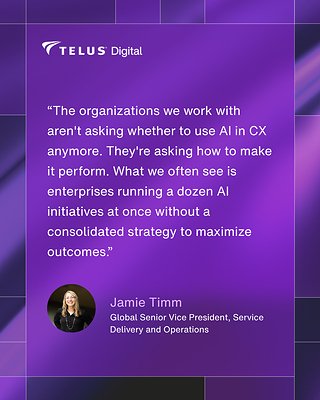
“The organizations we work with aren’t asking whether to use AI in CX anymore. They’re asking how to make it perform,” said Jamie Timm, Global Senior Vice President, Service Delivery and Operations, TELUS Digital. “What we often see is enterprises running a dozen AI initiatives at once without a consolidated strategy to maximize outcomes. To make AI truly perform for CX, we help enterprises do several things. First, take stock of AI deployment across the contact center, including the pre-contact phase like recruiting and training, the during-contact phase like real-time agent guidance, and the post-contact phase like quality assurance. Second, build the quality, insights and intelligence layer that tells them whether AI is working, heal knowledge gaps as they emerge, and apply those insights into future agent interactions. From there, align AI investment with the operational outcomes they’re trying to drive, and connect everything through an intelligence layer that ties AI use cases together as one coordinated system. That system doesn’t just collect performance data but activates what’s working across the AI ecosystem to drive performance. This gives enterprises a clear understanding of how to prioritize AI for enhancing CX.”
A gap between AI investment and AI infrastructure
The survey also shows a disconnect between where organizations plan to invest and the operational capabilities required to make those investments perform optimally. Three of the largest gaps between planned investment and current deployment are on the agent and operations side:
- AI copilots for real-time agent assistance: 56% of organizations plan to invest, while only 38% currently use real-time AI knowledge retrieval and guidance for agents: a gap of 18 percentage points.
- Intelligent knowledge management and search: 51% plan to invest in AI knowledge management tools, while only 34% currently use AI-powered knowledge base search integrated with agent workflows: a gap of 17 percentage points.
- Automated quality assurance and coaching: 46% plan to invest, while just 32% currently have AI-powered QA and agent coaching in place: a gap of 14 percentage points.
These capabilities can determine how agents assisted by AI perform. And yet, they are the ones enterprises are furthest behind on building.
Significant investment, misaligned priorities
The financial commitment behind enterprise CX is substantial. 61% of surveyed organizations said they spend more than $10 million annually on CX delivery and 40% increased their CX budget compared to the previous year. Only 13% reported a year-over-year decrease.
The survey also points to a gap between what enterprises are planning to build and what they have actually built. Enterprises are planning significant investment across AI capabilities, led by:
- AI copilots (56%)
- Chatbots and virtual assistants (55%)
- Self-service capabilities (48%)
The top stated priorities, however, sit on the operational side:
- CSAT/NPS improvement (47%)
- Consistency in service quality (45%)
- Cost reduction (38%)
By comparison, average handle time reduction ranked at just 19%, a sign the market has moved beyond efficiency-only thinking toward quality, consistency and customer outcomes. But planned investment consistently outpaces current deployment across every capability measured, and the gap is largest where the operational consequences are greatest.
How can enterprises get the most out of their AI investments?
To help enterprises close this gap, TELUS Digital offers Digital CX Transformation services built on its proprietary SMART CX framework: Strategy, Modern Channels, Agent Enablement, Revenue Growth and Tech Foundations. The framework provides a structured way to assess and improve every layer of an organization’s customer experience operation, connecting customer-facing experiences with the agent, technology and operational systems behind them.
A core part of TELUS Digital’s offering is the CX Strategic Assessment (CXSA). The CXSA is a diagnostic review that examines what is currently in place across a client’s CX environment, identifies what is and isn’t working, benchmarks digital maturity and prioritizes the technology and AI opportunities most likely to drive ROI. The findings inform a tailored roadmap covering the client’s tech stack, customer journey and agent enablement, including how AI training and literacy can support frontline teams in resolving issues faster with a unified view of the customer.
As a comprehensive CX transformation partner for Fortune 1000 brands, TELUS Digital draws on deep expertise in AI and customer experience consulting to help clients align technology, people, processes and business goals into measurable performance gains. To learn more, visit telusdigital.com/solutions/cx-consulting.
Survey methodology:
The Ryan Strategic Advisory 2026 CX Technology and Global Services Survey interviewed 815 enterprise executives, each of whom has strategic decision-making authority over contact centers in their respective organizations. Interviews were conducted over the telephone in Q1 2026 in English, French, Spanish, Italian, Japanese, Korean, Dutch or German (depending on the respondent’s country of residence). The revenue mix for respondents ranged from between $10 million to over $5 billion (USD).
Read the full Enterprise CX AI: 2026 Global Survey report at: telusdigital.com/insights/customer-experience/resource/enterprise-cx-ai-2026
Frequently asked questions
-
How does TELUS Digital help enterprises get started on optimizing AI in CX?
Research commissioned by TELUS Digital and conducted by Ryan Strategic Advisory in the Enterprise CX AI: 2026 Global Survey report shows that most enterprises operating contact centers have AI deployed across multiple customer-facing functions. However, only 32% currently use AI-powered QA and coaching tools, meaning the majority lack the automation needed to monitor how AI-assisted interactions are performing at scale, or connect their AI investments to the customer and business outcomes those investments are meant to drive. TELUS Digital helps enterprises take stock of AI deployment across the three phases of the contact center: pre-contact (recruiting and training), during contact (real-time agent guidance) and post-contact (quality assurance). From there, TELUS Digital helps enterprises identify what’s working and where the measurement gaps are, align AI investment with the operational outcomes they’re trying to drive, and connect those investments through an intelligence layer that ties AI use cases together. -
How can enterprises measure whether their AI investments are delivering on CX?
Measurement requires three operational capabilities: AI-powered quality assurance (QA), coaching infrastructure and performance measurement tools that connect customer experience outcomes to the AI investments driving them. Without these, enterprises can lack the real-time visibility to track how AI-assisted interactions are performing or to build a defensible return on investment (ROI) case. TELUS Digital’s CX Strategic Assessment (CXSA), built on its proprietary SMART CX framework, helps enterprises benchmark their measurement maturity and identify the highest-impact tools to put in place.
-
How can enterprises coordinate AI investments running across multiple parts of the contact center?
Many enterprises today are running or planning investments across as many as 12 different AI capability categories at the same time, often without a consolidated strategy to tie them together. This can result in a collection of disconnected tools rather than a coordinated system. TELUS Digital helps clients connect their AI investments through an intelligence layer that integrates their use cases, aligns them with business outcomes and turns scattered tools into a single, performance-driven CX operation.
-
Where should enterprises prioritize AI investment for maximum CX impact?
Customer-facing AI like chatbots are important, yet the survey shows enterprises are underinvesting in the operational capabilities that determine whether those tools actually deliver. Three of the AI capabilities with the largest gaps between planned investment and current deployment are on the agent and operations side, supporting both during-contact and post-contact phases of the customer interaction: AI copilots for real-time agent assistance, intelligent knowledge management and automated quality assurance and coaching. Enterprises that want to capture the full value of their AI spend should invest in the operational layer that supports the customer-facing tools, not just the tools themselves.
-
What do TELUS Digital’s customer experience consulting services include?
TELUS Digital partners with Fortune 1000 brands to transform their CX journey end-to-end, from frontend digital experiences to backend operational systems. Its customer experience consulting services span customer journey mapping and CX strategy development, digital transformation and omnichannel experience, digital maturity benchmarking and roadmapping, and tech and AI opportunity prioritization. This work is grounded in TELUS Digital’s SMART CX framework, which connects customer-facing experiences with the agent, technology and operational systems behind them to align technology, people, processes and business goals into sustainable, revenue-generating impact. Enterprises evaluating top customer experience consulting firms should look for partners that combine this kind of deep AI expertise with proven CX transformation frameworks.
-
What does TELUS Digital’s SMART CX framework do for enterprises?
SMART CX is TELUS Digital’s proprietary framework for CX transformation. It covers five layers: Strategy and value capture, Modern channels, Agent enablement, Revenue growth and Tech and data foundations. The framework provides a structured way to assess and improve every layer of an organization’s customer experience operation, connecting customer-facing experiences with the agent, technology and operational systems behind them. It’s designed to help enterprises move from fragmented AI deployment to coordinated CX performance.
About TELUS Digital
TELUS Digital crafts unique and enduring experiences for customers and employees, and creates future-focused digital transformations that deliver value for our clients. We are the brand behind the brands. Our global team members are both passionate ambassadors of our clients’ products and services, and technology experts resolute in our pursuit to elevate their end customer journeys, solve business challenges, mitigate risks, and drive continuous innovation. Our portfolio of end-to-end, integrated capabilities include customer experience management, digital solutions, such as cloud solutions, AI-fueled automation, front-end digital design and consulting services, AI & data solutions, including computer vision, and trust, safety and security services. Fuel iXTM is TELUS Digital’s proprietary platform and suite of products for clients to manage, monitor, and maintain generative AI across the enterprise, offering both standardized AI capabilities and custom application development tools for creating tailored enterprise solutions.
Powered by purpose, TELUS Digital leverages technology, human ingenuity and compassion to serve customers and create inclusive, thriving communities in the regions where we operate around the world. Guided by our Humanity-in-the-Loop principles, we take a responsible approach to the transformational technologies we develop and deploy by proactively considering and addressing the broader impacts of our work. Learn more at: telusdigital.com
Contacts:
TELUS Digital Media Relations
Jackie Paduano
[email protected]
TELUS Investor Relations
Olena Lobach
[email protected]

 View original content to download multimedia:https://www.prnewswire.com/news-releases/deployed-but-not-optimized-telus-digital-and-ryan-strategic-advisory-reveal-the-ai-performance-gap-in-enterprise-cx-for-2026-302789046.html
SOURCE TELUS Digital
