
PR Newswire
CALGARY, AB, June 24, 2026 /PRNewswire/ — The greenhouse gas intensity of Canadian oil sands production has declined for a 13th straight year, according to a new analysis by S&P Global Energy. Since 2009, annual emissions intensity has declined every year but one (2012).
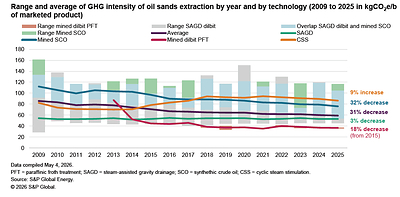
The annual S&P Global Energy analysis finds that the benchmark average GHG intensity of oil sands production declined 2% to 59 kilograms of “carbon dioxide equivalent” per barrel (kgCO2e/bbl) in 2025, the most recent calendar year available.
Since 2009, the average GHG intensity of oil sands production has declined by 31%, or nearly 27 kgCO2e/b of marketable product.
“The downward trajectory of oil sands emissions intensity is now a well-established, multi-decade trend,” said Kevin Birn, Vice President, Head of Carbon Research, S&P Global Energy. “Ongoing optimization efforts to maximize output from existing facilities, which are much more capital efficient compared to new projects, has been a critical factor, and this is expected to continue.”
Improvements in mining operations experienced the greatest gains, which came from improved fleet optimization, better waste-heat integration, improved predictive maintenance and shorter maintenance turnaround periods, the analysis finds.
Integrated mines have also been where the larger step-out technologies have been tested and deployed, such as the completion of the Quest Carbon Capture, Utilization and Storage (CCUS) project in 2015 and Suncor’s coke boiler replacement in 2024. Meanwhile greater volumes of steam-assisted gravity drainage (SAGD) and Mined dilibit—operations on average less intensive than integrated mines—diluted and reduced the overall industry average.
While GHG intensity continues to decline, absolute emissions from oil sands have continued to rise, but at a slower rate. Between 2024-2025, absolute emissions rose 2% on account of a 150,000 b/d rise in overall production.
“As oil sands output has increased, emissions have been spread over more units pushing intensity lower, even as it also pushed absolute emissions higher, but at a slowing rate,” Birn said. “With growing speculation that oil sands production growth may accelerate, absolute emissions growth should also be expected to rise without the application of CCUS. However, the learnings over the past two decades may mean these barrels still come at even lower intensity.”
Media Contacts:
Jeff Marn
S&P Global Energy
+1 202 463 8213
[email protected]
About S&P Global Energy
At S&P Global Energy, our comprehensive view of global energy and commodities markets enables our customers to make superior decisions and create long-term, sustainable value. Our four core capabilities are: Platts for pricing and news; CERA for research and advisory; Horizons for energy expansion and sustainability solutions; and Events for industry collaboration.
S&P Global Energy is a division of S&P Global (NYSE: SPGI). S&P Global enables businesses, governments, and individuals with trusted data, expertise, and technology to make decisions with conviction. We are Advancing Essential Intelligence through world-leading benchmarks, data, and insights that customers need in order to plan confidently, act decisively, and thrive in a rapidly changing global landscape. Learn more at www.spglobal.com/energy.

 View original content to download multimedia:https://www.prnewswire.com/news-releases/canadian-oil-sands-greenhouse-gas-intensity-continues-a-17-year-decline–down-nearly-one-third-since-2009-sp-global-energy-analysis-finds-302809420.html
SOURCE S&P Global Energy
