Scapa Healthcare Announces Expansion of Sterilisation Irradiation Services in the UK

Proven Track Record of Technical Expertise Supporting Customers’ Product Sterility Requirements

WINDSOR, Conn., Nov. 19, 2020 (GLOBE NEWSWIRE) — Scapa Healthcare, the trusted strategic partner of choice for the world’s leading companies in advanced wound care, consumer wellness and medical device & fixation, announces that it is increasing the capacity of its comprehensive irradiation services at its Gargrave, UK facility to meet growing demand for irradiation services for medical devices and pharmaceutical products.

Scapa Healthcare provides a full range of sterilisation services including in-house gamma irradiation, microbiology, storage, product stability and global product distribution as well as technical expertise in electron beam and ethylene oxide sterilisation methods.

The facility is equipped to precisely and reproducibly sterilize a wide variety of medical devices and pharmaceutical products composed of different materials, densities, dose requirements and material composition. Scapa’s team of experts’ integrated approach underpins customer’s requirement and supports sterility label claims under ISO 13485 and ISO 11137 accreditations. Scapa’s microbiologists and technical specialists collaborate across all areas of product sterility through the company’s Microbiology Quality Assurance services.

“Scapa Healthcare is recognized as a leader in delivering premium life sciences turn-key solutions to our customers,” said Matt Ellison, General Manager, Europe and UK, Scapa Healthcare. “Our dedicated team of experts at the Gargrave site work closely with customers, guiding and leading throughout the process from product development to distribution and logistics of finished goods to ensure we meet and exceed customer requirements. We strive to be the partner of choice for leading healthcare companies by providing fast and efficient turnaround times along with the highest quality of customer service.”

For more information about Scapa Healthcare full offering of sterilisation services, please visit: https://www.scapahealthcare.com/services/sterilisation

About Scapa Healthcare

Scapa Healthcare is the trusted strategic partner of choice for the world’s leading companies in advanced wound care, consumer wellness and medical device & fixation. Our strategy is to partner with market leaders to develop and manufacture innovative skin friendly medical device fixation and topical solutions. Through pursuing these partnerships, Scapa now provides integrated services to the top global MedTech companies. Our state-of-the-art facilities enable Scapa Healthcare to offer customers the whole spectrum of production services from inception through to market delivery. For more information visit: scapahealthcare.com or email [email protected].


Media Contact
Hillary Lima
SVM Public Relations and Marketing Communications
[email protected]
(401) 490-9700

Scapa Healthcare Contact 
Lee Barrett
[email protected]

The Children’s Place Reports Third Quarter 2020 Results

Reports
Q3
GAAP Earnings per Diluted Share of $0.91 versus $2.77 in Q32019

Reports
Q3
Adjusted Earnings per Diluted Share of $1.44 versus $3.03 in Q3 2019

SECAUCUS, N.J., Nov. 19, 2020 (GLOBE NEWSWIRE) — The Children’s Place, Inc. (Nasdaq: PLCE), the largest pure-play children’s specialty apparel retailer in North America, today announced financial results for the third quarter ended October 31, 2020.

Jane Elfers, President and Chief Executive Officer, said, “As expected, revenue during our peak back-to-school period was significantly impacted by the move to remote and hybrid learning models. Post the back-to-school peak, when our assortments converted to more casual options and the weather turned cooler, our sales improved. Importantly, we returned to profitability and generated positive cash flow from operations for the third quarter.”

Ms. Elfers continued, “Our digital sales penetration increased to 44% in the third quarter and year-to-date, our digital sales represent 55% of total sales. Since the onset of the COVID-19 pandemic in March, we have increased the number of new digital customers versus last year by approximately 100%, converted over 800,000 of our store-only customers to omni-channel customers, and increased our mobile app downloads by over 60% versus last year. Combined, these metrics provide a strong foundation for continued digital growth as digital adoption, accelerated by the COVID-19 pandemic, continues to drive online sales to an increasingly greater share of total sales. Importantly, we remain on track to close 300 stores by the end of fiscal 2021, with a plan of 200 store closures in fiscal 2020, inclusive of the 118 stores that have permanently closed in the first nine months of 2020, and 100 store closures in fiscal 2021.”

Ms. Elfers concluded, “We are approaching the fourth quarter with heightened caution and expect both sales and profitability to be under pressure due to the numerous headwinds created by the pandemic, specifically: the reduced demand for dress-up product, significantly reduced store traffic, recent nationwide spikes in COVID-19 cases resulting in additional temporary store closures, social distancing requirements, and reduced mall operating hours.  In addition, the capacity constraints across the domestic transportation network resulting from the unprecedented level of expected online demand and the related freight surcharges imposed by our major carriers will put additional pressure on sales and margins during Q4.  While we continue to manage through these short-term headwinds during this extraordinary time, our focus remains on successfully scaling our digital transformation investments and accelerating store closures to position the Company for accelerated operating margin expansion in a post-COVID environment.”

Third Quarter 2020 Results

Net sales decreased 19% to $425.6 million in the three months ended October 31, 2020 compared to $524.8 million in the three months ended November 2, 2019, primarily as a result of a decrease in back-to-school sales due to schools adopting remote and hybrid learning models, along with the impact of permanent and temporary store closures.

Gross profit was $146.1 million in the three months ended October 31, 2020, compared to $198.1 million in the three months ended November 2, 2019. Adjusted gross profit was $151.7 million in the three months ended October 31, 2020, compared to $198.1 million in the comparable period last year, and deleveraged 210 basis points to 35.7% of net sales. The decrease was primarily a result of increased penetration of our e-commerce business and its higher fulfillment costs, along with the deleverage of fixed expenses resulting from the decline in net sales, partially offset by higher merchandise margins in both our stores and e-commerce channels.

Selling, general, and administrative expenses were $106.6 million in the three months ended October 31, 2020, compared to $120.5 million in the three months ended November 2, 2019. Adjusted SG&A was $103.5 million in the three months ended October 31, 2020, compared to $116.6 million in the comparable period last year, and deleveraged 210 basis points to 24.3% of net sales, primarily as a result of the deleverage of fixed expenses resulting from the decline in net sales and higher incentive compensation accruals. This was partially offset by a reduction in store expenses resulting from our permanent store closures, as well as a reduction in operating expenses associated with actions taken in response to the COVID-19 pandemic.

Operating income was $23.3 million in the three months ended October 31, 2020, compared to $58.0 million in the three months ended November 2, 2019. Adjusted operating income was $33.3 million in the three months ended October 31, 2020, compared to $63.4 million in the comparable period last year, and deleveraged 430 basis points to 7.8% of net sales.

Net income was $13.3 million, or $0.91 per diluted share, in the three months ended October 31, 2020, compared to net income of $43.0 million, or $2.77 per diluted share, in the three months ended November 2, 2019. Adjusted net income was $21.1 million, or $1.44 per diluted share, compared to adjusted net income of $47.1 million, or $3.03 per diluted share, in the comparable period last year.

Fiscal Year-To-Date 2020 Results

Net sales decreased 22.7% to $1.050 billion in the nine months ended October 31, 2020 compared to $1.358 billion in the nine months ended November 2, 2019, primarily as a result of permanent and temporary store closures, along with a decrease in back-to-school sales beginning in mid-July due to schools adopting remote and hybrid learning models, partially offset by increased e-commerce sales.

Gross profit was $193.5 million in the nine months ended October 31, 2020, compared to $488.9 million in the nine months ended November 2, 2019. Adjusted gross profit was $313.9 million in the nine months ended October 31, 2020, compared to $488.4 million in the comparable period last year, and deleveraged 610 basis points to 29.9% of net sales, primarily as a result of increased penetration of our e-commerce business and its higher fulfillment costs, along with the deleverage of fixed expenses resulting from the decline in net sales.

Selling, general, and administrative expenses were $319.4 million in the nine months ended October 31, 2020, compared to $364.9 million in the nine months ended November 2, 2019. Adjusted SG&A was $295.1 million in the nine months ended October 31, 2020, compared to $359.3 million in the comparable period last year, and deleveraged 160 basis points to 28.1% of net sales, primarily as a result of the deleverage of fixed expenses resulting from the decline in net sales and higher incentive compensation accruals, partially offset by a reduction in store expenses resulting from our permanent store closures, as well as a reduction in operating expenses associated with actions taken in response to the COVID-19 pandemic.

Operating loss was ($214.3) million in the nine months ended October 31, 2020, compared to operating income of $66.8 million in the nine months ended November 2, 2019. Adjusted operating loss was ($29.5) million in the nine months ended October 31, 2020, compared to adjusted operating income of $75.9 million in the comparable period last year, and deleveraged 840 basis points to (2.8%) of net sales.

Net loss was ($148.1) million, or ($10.13) per diluted share, in the nine months ended October 31, 2020, compared to net income of $49.1 million, or $3.10 per diluted share, in the nine months ended November 2, 2019.  Adjusted net loss was ($29.2) million, or ($2.00) per diluted share, compared to adjusted net income of $55.9 million, or $3.53 per diluted share, in the comparable period last year.

Non-GAAP Reconciliation

The Company’s results are reported in this press release on a GAAP and as adjusted, non-GAAP basis. Adjusted net income (loss), adjusted net income (loss) per diluted share, adjusted gross profit, adjusted selling, general, and administrative expenses, and adjusted operating income (loss) are non-GAAP measures, and are not intended to replace GAAP financial information, and may be different from non-GAAP measures reported by other companies. The Company believes the income and expense items excluded as non-GAAP adjustments are not reflective of the performance of its core business, and that providing this supplemental disclosure to investors will facilitate comparisons of the past and present performance of its core business.

For the three months ended October 31, 2020, the Company’s adjusted results exclude net expenses of approximately $10.0 million, primarily related to the impact of the COVID-19 pandemic, including incremental COVID-19 operating expenses, including incentive pay and personal protective equipment for our associates, and occupancy charges for rent at our stores temporarily closed.

The total impact on income taxes for the above items was approximately $2.2 million, including a provision of approximately $0.5 million, primarily resulting from the changes in operating loss carryback rules as a result of the Coronavirus Aid, Relief, and Economic Security (“CARES”) Act.

For the nine months ended October 31, 2020, the Company recorded an inventory provision of approximately $63.2 million and approximately $37.9 million of impairment charges, including the right-of-use assets recorded in connection with the adoption of the new lease accounting standard. The inventory provision relates to the adverse business disruption resulting from the COVID-19 pandemic, including the store closures. The impairment charges were primarily a result of decreased net revenue and cash flow projections resulting from the COVID-19 pandemic disruption.

In addition to the inventory provision and impairment charges, the Company’s adjusted results for the nine months ended October 31, 2020 exclude net expenses of approximately $75.3 million, primarily related to the impact of the COVID-19 pandemic, including occupancy charges for rent at our stores temporarily closed; incremental COVID-19 operating expenses, including incentive pay and personal protective equipment for our associates; and payroll and benefits for certain store employees during the period our stores were closed, net of a payroll tax credit benefit resulting from the CARES Act.

Additionally, the Company excluded net costs of approximately $8.4 million for the nine months ended October 31, 2020, primarily related to restructuring costs.

The total impact on income taxes for the above items was approximately $65.9 million, including a benefit of approximately $16.9 million, primarily resulting from the changes in operating loss carryback rules as a result of the CARES Act.

Store Update

As of October 31, 2020, the Company had 99% of its stores open to the public in the U.S., Canada, and Puerto Rico.

Consistent with the Company’s store fleet optimization initiative, the Company permanently closed 16 stores in the three months ended October 31, 2020. The Company ended the quarter with 809 stores and square footage of 3.8 million, a decrease of 14.3% compared to the prior year. Since the Company’s fleet optimization initiative was announced in 2013, it has closed 389 stores.

The flexibility provided by lease actions allows the Company to target 200 store closures in fiscal 2020, including 118 stores closed in the first nine months of fiscal 2020, and 100 additional closures in fiscal 2021.

Balance Sheet and Cash Flow

As of October 31, 2020, the Company had approximately $64.5 million of cash and cash equivalents and $179.4 million outstanding on its revolving credit facility. During the third quarter, the Company completed an $80 million term loan financing transaction and utilized the net proceeds to pay down its existing revolving credit facility.  Additionally, the Company generated approximately $32.5 million in operating cash flow in the three months ended October 31, 2020.

Outlook

As a result of the continued uncertainty created by the COVID-19 pandemic, the Company is not providing financial guidance at this time.

Conference Call Information 

The Children’s Place will host a conference call on Thursday, November 19, 2020 at 8:00 a.m. Eastern Time to discuss its third quarter fiscal 2020 results.

The call will be broadcast live at http://investor.childrensplace.com. An audio archive will be available on the Company’s website approximately one hour after the conclusion of the call. A conference call transcript will also be posted on our website.

About The Children’s Place
The Children’s Place is the largest pure-play children’s specialty apparel retailer in North America. The Company designs, contracts to manufacture, sells at retail and wholesale, and licenses to sell fashionable, high-quality merchandise predominantly at value prices, primarily under the proprietary “The Children’s Place”, “Place”, “Baby Place”, and “Gymboree” brand names. As of October 31, 2020, the Company had 809 stores in the United States, Canada, and Puerto Rico, online stores at www.childrensplace.com and www.gymboree.com, and the Company’s eight international franchise partners had 252 international points of distribution in 19 countries.

Forward Looking Statements

This press release, contains or may contain forward-looking statements made pursuant to the safe harbor provisions of the Private Securities Litigation Reform Act of 1995, including but not limited to statements relating to the Company’s strategic initiatives and adjusted net income per diluted share. Forward-looking statements typically are identified by use of terms such as “may,” “will,” “should,” “plan,” “project,” “expect,” “anticipate,” “estimate” and similar words, although some forward-looking statements are expressed differently. These forward-looking statem
ents are based upon the Company’
s current expectations and assumptions and are subject to various risks and uncertainties that could cause actual results and performance to differ materially. Some of these risks and uncertainti
es are described in the Company’
s filings with the Securities and Exchange Commission, including in the “Risk Factors” section of its annual report on Form 10-K for the fiscal year ended February 1, 2020 and supplemented by the “Risk Factors” sections of its quarterly reports on Form 10-Q for the fiscal quarter ended May 2, 2020 and the fiscal quarter ended August 1, 2020. Included among the risks and uncertainties that could cause actual results and performance to differ materially are the risk that the Company will be unsuccessful in gauging fashion trends and changing consumer preferences, the risks resulting from the highly competitive nature of the Company’s business and its dependence on consumer spending patterns, which may be affected by changes in economic conditions, the risks related to the COVID-19 pandemic, including the impact of the COVID-19 pandemic on our business or the economy in general (including decreased customer traffic, schools adopting remote and hybrid learning models, closures of businesses and other activities causing decreased demand for our products and negative impacts on our customers’ spending patterns due to decreased income or actual or perceived wealth, and the impact of the CARES Act and other legislation related to the COVID-19 pandemic, and any changes to the CARES Act or such other legislation), the risk that the Company’s strategic initiatives to increase sales and margin are delayed or do not result in
anticipated improvements, the risk of delays, interruptions and disruptions in the Company’s global supply chain, including resulting from COVID-19 or other disease outbreaks, or foreign sources of supply in less developed countries or more politically unstable countries, the risk that the cost of raw materials or energy prices will increase beyond current expectations or that the Company is unable to offset cost increases through value engineering or price increases, various types of litigation, including class action litigations brought under consumer protection, employment, and privacy and information security laws and regulations, the imposition of regulations affecting the importation of foreign-produced merchandise, including duties and tariffs, and the uncertainty of weather patterns. Readers are cautioned not to place undue reliance on these forward-looking statements, which speak only as of the date they were made. The Company undertakes no obligation to release publicly any revisions to these forward-looking statements that may be made to reflect events or circumstances after the date hereof or to reflect the occurrence of unanticipated events.

Contact:  Investor Relations (201) 558-2400 ext. 14500

(Tables follow)

THE CHILDREN’S PLACE, INC.

CONDENSED CONSOLIDATED STATEMENTS OF OPERATIONS

(In thousands, except per share amounts)
(Unaudited)

 
Third Quarter Ended
 
Year-To-Date Ended
  October 31,   November 2, October 31,   November 2,
    2020       2019       2020       2019  
Net sales $ 425,571     $ 524,796     $ 1,049,701     $ 1,357,647  
Cost of sales   279,506       326,671       856,229       868,701  
Gross profit   146,065       198,125       193,472       488,946  
Selling, general and administrative expenses   106,639       120,514       319,442       364,937  
Asset impairment charges   294       839       37,929       1,308  
Depreciation and amortization   15,809       18,821       50,405       55,877  
Operating income (loss)   23,323       57,951       (214,304 )     66,824  
Interest expense, net   (3,263 )     (2,155 )     (7,742 )     (6,144 )
Income (loss) before taxes   20,060       55,796       (222,046 )     60,680  
Provision (benefit) for income taxes   6,740       12,748       (73,917 )     11,620  
Net income (loss) $ 13,320     $ 43,048     $ (148,129 )   $ 49,060  
               
               
Earnings (loss) per common share              
Basic $ 0.91     $ 2.78     $ (10.13 )   $ 3.12  
Diluted $ 0.91     $ 2.77     $ (10.13 )   $ 3.10  
               
Weighted average common shares outstanding              
Basic   14,639       15,497       14,628       15,720  
Diluted   14,643       15,546       14,628       15,837  
               

THE CHILDREN’S PLACE, INC.

RECONCILIATION OF NON-GAAP FINANCIAL INFORMATION TO GAAP

(In thousands, except per share amounts)

(Unaudited)

 
Third Quarter Ended
 
Year-To-Date Ended
  October 31,   November 2,


  October 31,   November 2,
    2020       2019       2020       2019  
               
Net income (loss) $ 13,320     $ 43,048     $ (148,129 )   $ 49,060  
               
Non-GAAP adjustments:              
Incremental COVID-19 operating expenses   5,416             17,630        
Occupancy charges   1,915             48,973        
Restructuring costs   916       1,435       7,337       2,118  
Accelerated depreciation   827       777       2,171       2,667  
Fleet optimization   621       1,221       1,271       1,193  
Asset impairment charges   294       839       37,929       1,308  
Inventory provision               63,247        
Store payroll and benefits, net of CARES Act retention credit               4,242        
Accounts receivables               1,081        
Gymboree integration costs         494       640       1,068  
Legal reserve               302        
Distribution facility start-up costs         721             721  
Aggregate impact of Non-GAAP adjustments   9,989       5,487       184,823       9,075  
Income tax effect(1)   (2,647 )     (1,454 )     (48,955 )     (2,405 )
Prior year uncertain tax positions(2)                     135  
Impact of CARES Act   450             (16,928 )      
Net impact of Non-GAAP adjustments   7,792       4,033       118,940       6,805  
               
Adjusted net income (loss) $ 21,112     $ 47,081     $ (29,189 )   $ 55,865  
               
GAAP net income (loss) per common share $ 0.91     $ 2.77     $ (10.13 )   $ 3.10  
               
Adjusted net income (loss) per common share $ 1.44     $ 3.03     $ (2.00 )   $ 3.53  
               
(1) The tax effects of the non-GAAP items are calculated based on the statutory rate of the jurisdiction in which the discrete item resides.      
               
(2) Prior year tax related to uncertain tax positions.      


Third Quarter Ended
 
Year-To-Date Ended
  October 31,   November 2,


  October 31,   November 2,
    2020       2019       2020       2019  
               
Operating income (loss) $ 23,323     $ 57,951     $ (214,304 )   $ 66,824  
               
Non-GAAP adjustments:              
Incremental COVID-19 operating expenses   5,416             17,630        
Occupancy charges   1,915             48,973        
Restructuring costs   916       1,435       7,337       2,118  
Accelerated depreciation   827       777       2,171       2,667  
Fleet optimization   621       1,221       1,271       1,193  
Asset impairment charges   294       839       37,929       1,308  
Inventory provision               63,247        
Store payroll and benefits, net of CARES Act retention credit               4,242        
Accounts receivables               1,081        
Gymboree integration costs         494       640       1,068  
Legal reserve               302        
Distribution facility start-up costs         721             721  
Aggregate impact of Non-GAAP adjustments   9,989       5,487       184,823       9,075  
               
Adjusted operating income (loss) $ 33,312     $ 63,438     $ (29,481 )   $ 75,899  
               

THE CHILDREN’S PLACE, INC.

RECONCILIATION OF NON-GAAP FINANCIAL INFORMATION TO GAAP

(In thousands, except per share amounts)

(Unaudited)

 
Third Quarter Ended
 
Year-To-Date Ended
  October 31,   November 2,


  October 31,   November 2,
    2020       2019       2020       2019  
               
Gross profit $ 146,065     $ 198,125     $ 193,472     $ 488,946  
               
Non-GAAP adjustments:              
Incremental COVID-19 operating expenses   3,769             8,204        
Occupancy charges   1,915             48,973        
Inventory provision               63,247        
Fleet optimization                     (550 )
Aggregate impact of Non-GAAP adjustments   5,684             120,424       (550 )
               
Adjusted Gross profit $ 151,749     $ 198,125     $ 313,896     $ 488,396  


Third Quarter Ended
 
Year-To-Date Ended
  October 31,   November 2,


  October 31,   November 2,
    2020       2019       2020       2019  
               
Selling, general and administrative expenses $ 106,639     $ 120,514     $ 319,442     $ 364,937  
               
Non-GAAP adjustments:              
Incremental COVID-19 operating expenses   (1,647 )           (9,426 )      
Restructuring costs   (916 )     (1,435 )     (7,337 )     (2,126 )
Fleet optimization   (621 )     (1,221 )     (1,271 )     (1,735 )
Store payroll and benefits, net of CARES Act retention credit               (4,242 )      
Accounts receivables               (1,081 )      
Gymboree integration costs         (494 )     (640 )     (1,068 )
Legal reserve               (302 )      
Distribution facility start-up costs         (721 )           (721 )
Aggregate impact of Non-GAAP adjustments   (3,184 )     (3,871 )     (24,299 )     (5,650 )
               
Adjusted Selling, general and administrative expenses $ 103,455     $ 116,643     $ 295,143     $ 359,287  
               

THE CHILDREN’S PLACE, INC.

CONDENSED CONSOLIDATED BALANCE SHEETS

(In thousands)

(Unaudited)

  October 31,   February 1,
  November 2,
    2020     2020*
  2019
Assets:              
Cash and cash equivalents $ 64,456     $ 68,487     $ 66,059  
Accounts receivable   31,376       32,812       39,471  
Inventories   427,629       327,165       389,815  
Other current assets   16,159       21,416       20,722  
Total current assets   539,620       449,880       516,067  
               
Property and equipment, net   191,544       236,898       246,234  
Right-of-use assets   297,206       393,820       418,151  
Tradenames, net   72,692       73,291       73,386  
Other assets, net   105,881       27,508       31,884  
Total assets $ 1,206,943     $ 1,181,397     $ 1,285,722  
               
Liabilities and Stockholders’ Equity:              
Revolving loan $ 179,360     $ 170,808     $ 184,179  
Accounts payable   283,943       213,115       235,491  
Current lease liabilities   171,276       121,868       124,281  
Accrued expenses and other current liabilities   142,180       89,216       116,647  
Total current liabilities   776,759       595,007       660,598  
               
Long-term lease liabilities   232,153       311,908       331,615  
Term Loan   76,307              
Other liabilities   44,355       39,295       39,070  
Total liabilities   1,129,574       946,210       1,031,283  
               
Stockholders’ equity   77,369       235,187       254,439  
               
Total liabilities and stockholders’ equity $ 1,206,943     $ 1,181,397     $ 1,285,722  
               

* Derived from the audited consolidated financial statements included in the Company’s Annual Report on Form 10-K for the fiscal year ended February 1, 2020.

THE CHILDREN’S PLACE, INC.

CONDENSED CONSOLIDATED CASH FLOWS

(In thousands)

(Unaudited)

 
39 Weeks Ended
 
39 Weeks Ended
  October 31,   November 2,
    2020       2019  
       
Net income (loss) $ (148,129 )   $ 49,060  
Non-cash adjustments   96,925       184,043  
Working capital   473       (132,537 )
Net cash provided by (used in) operating activities   (50,731 )     100,566  
       
Net cash used in investing activities   (23,552 )     (119,125 )
       
Net cash provided by financing activities   70,686       15,075  
       
Effect of exchange rate changes on cash   (434 )     407  
       
Net decrease in cash and cash equivalents   (4,031 )     (3,077 )
       
Cash and cash equivalents, beginning of period   68,487       69,136  
       
Cash and cash equivalents, end of period $ 64,456     $ 66,059  


Ocuphire Pharma Announces First Patient Enrolled in MIRA-2 Phase 3 Clinical Trial Investigating Nyxol® for Reversal of Mydriasis

Begins Enrollment in the First of Four Upcoming Late-Stage Trials in the U.S.

Announces MIRA-1 Phase 2b Study Accepted for Peer-Reviewed Publication in Optometry and Vision Science

FARMINGTON HILLS, Mich., Nov. 19, 2020 (GLOBE NEWSWIRE) — Ocuphire Pharma, Inc., (Nasdaq: OCUP) a clinical-stage ophthalmic biopharmaceutical company focused on developing and commercializing therapies for the treatment of several eye disorders, announced today the enrollment of the first patient in its MIRA-2 (NCT04620213) Phase 3 registration clinical trial evaluating the safety and efficacy of Nyxol® to reverse pharmacologically-induced mydriasis. A majority of the 12 clinical sites located around the US are open and recruiting as of this week.

Approximately 100 million eye exams are performed annually in the U.S., most of which require dilation (mydriasis) of the pupil to properly examine the back of the eye. In addition, 4 million eyes are dilated each year for surgical procedures. This pharmacologically-induced dilation can last anywhere from 6 to 24 hours depending on individual patient characteristics. These dilated eyes have heightened sensitivity to light and inability to focus on near objects, causing patients difficulty with activities such as reading, working, and driving. In a recently completed market research study surveying several hundred patients and eye care providers (optometrists and ophthalmologists) conducted by GlobalData, an estimated 45% of patients were very likely to request a reversal drop and over 40% of eye care providers were likely to use a reversal drop if such a treatment option was approved and commercially available.

Nyxol, a proprietary and stable eye drop formulation of phentolamine mesylate, has demonstrated reversing mydriasis in a recently completed Phase 2b clinical trial (MIRA-1). Nyxol eye drops work by reducing pupil size through acting on the iris dilator muscle, allowing patients to return to their normal pupil size more rapidly. The objectives of the MIRA-2 trial are to evaluate the efficacy and safety of Nyxol compared to placebo in healthy patients to reverse pharmacologically-induced mydriasis across several commonly used mydriatic (dilating) drops. This 24-hour, multi-center, randomized, double-masked, placebo-controlled Phase 3 registration trial is expected to enroll 168 patients with top-line results expected in Q1 2021. This is the first of two registration trials planned in this acute indication for eventual New Drug Application (NDA) submission.

“Any patient who has had a routine eye exam has experienced the frustrations that come with prolonged dilation, and many request some form of reversal agent. As of now, we have no current commercially available options to offer, so we are excited to start this Phase 3 registration trial to evaluate Nyxol as a potential reversal agent,” said Paul Karpecki, OD, Director of Cornea Services for Kentucky Eye Institute in Lexington KY.

Mina Sooch, President and CEO of Ocuphire Pharma added, “With so many eye exams performed every year that require dilation, there is a clear need for a safe and effective option to accelerate the return of patients to their daily activities and everyday vision. We designed the MIRA-2 Phase 3 trial to build on the positive results of our recently completed Phase 2b MIRA-1 trial which were presented at ARVO in May 2020. This is the first of our four planned clinical trials for Nyxol and APX3330. We are at various stages of start-up activities across these trials, and look forward to timely enrollment on this MIRA-2 Phase 3 trial in collaboration with our CRO partner, Oculos Development Services.”

For more information about the MIRA-2 (NCT04620213) Phase 3 registration trial design and its US clinical sites, please visit www.clinicaltrials.gov.

Ocuphire is also pleased to announce the acceptance of a peer-reviewed written publication of the MIRA-1 study “Phentolamine Eye Drops Reverse Pharmacologically Induced Mydriasis in a Randomized Phase 2b Trial” in Optometry and Vision Science (OVS), Journal of the American Academy of Optometry.Accepted articles will appear soon in print and on-line at www.optvissci.com.

About Ocuphire Pharma

Ocuphire is a publicly traded (NASDAQ: OCUP), clinical-stage ophthalmic biopharmaceutical company focused on developing and commercializing therapies for the treatment of several eye disorders. Ocuphire’s pipeline currently includes two small-molecule product candidates targeting front and back of the eye indications. The company’s lead product candidate, Nyxol® Eye Drops, is a once-daily preservative-free eye drop formulation of phentolamine mesylate, a non-selective alpha-1 and alpha-2 adrenergic antagonist designed to reduce pupil size, and is being developed for several indications, including dim light or night vision disturbances (NVD), reversal pharmacologically-induced mydriasis (RM), and presbyopia. Ocuphire’s second product candidate, APX3330, is a twice-a-day oral tablet, designed to inhibit angiogenesis and inflammation pathways relevant to retinal and choroidal vascular diseases, such as diabetic retinopathy (DR) and diabetic macular edema (DME). Nyxol is entering Phase 3 clinical development for NVD and RM, and Phase 2 for presbyopia. APX3330 is entering Phase 2 clinical development for DR/DME. As part of its strategy, Ocuphire will continue to explore opportunities to acquire additional ophthalmic assets and to seek strategic partners for late stage development, regulatory preparation and commercialization of drugs in key global markets. Please visit www.clinicaltrials.gov to learn more about Ocuphire’s recent Phase 2 clinical trials and upcoming trials. For more information, please visit www.ocuphire.com.


Forward Looking Statements

Statements contained in this press release regarding matters that are not historical facts are “forward-looking statements” within the meaning of the Private Securities Litigation Reform Act of 1995. Such statements include, but are not limited to, statements concerning Ocuphire’s product candidates and potential. These forward-looking statements are based upon Ocuphire’s current expectations and involve assumptions that may never materialize or may prove to be incorrect. Actual results and the timing of events could differ materially from those anticipated in such forward-looking statements as a result of various risks and uncertainties, including, without limitation: (i) the success and timing of regulatory submissions and pre-clinical and clinical trials; (ii) regulatory requirements or developments; (iii) changes to clinical trial designs and regulatory pathways; (iv) changes in capital resource requirements; (v) risks related to the inability of Ocuphire to obtain sufficient additional capital to continue to advance its product candidates and its preclinical programs; (vi) legislative, regulatory, political and economic developments, and (vii) the effects of COVID-19 on clinical programs and business operations. The foregoing review of important factors that could cause actual events to differ from expectations should not be construed as exhaustive and should be read in conjunction with statements that are included herein and elsewhere, including the risk factors detailed in documents that have been and may be filed by Ocuphire from time to time with the SEC (including the proxy statement/prospectus included in that certain Registration Statement on Form S-4 (File No. 333-239702) initially filed with the SEC on July 6, 2020 and declared effective by the SEC on October 2, 2020. All forward-looking statements contained in this press release speak only as of the date on which they were made. Ocuphire undertakes no obligation to update such statements to reflect events that occur or circumstances that exist after the date on which they were made.

Ocuphire Contacts

Mina Sooch, President & CEO 
Ocuphire Pharma, Inc. 
[email protected]
www.ocuphire.com 

Corey Davis, Ph.D.
LifeSci Advisors
[email protected] 


Sobi and Apellis announce first patient dosed in potentially registrational ALS study of pegcetacoplan

– 52-week phase 2 MERIDIAN study to evaluate pegcetacoplan, a targeted C3 therapy, in approximately 200 adults with ALS

PR Newswire

STOCKHOLM and WALTHAM, Mass., Nov. 19, 2020 /PRNewswire/ — Swedish Orphan Biovitrum AB (publ) (SobiTM) (STO:SOBI) and Apellis Pharmaceuticals, Inc. (Nasdaq: APLS) today announced that the first patient has been dosed in the potentially registrational phase 2 MERIDIAN study of pegcetacoplan, a targeted C3 therapy, in approximately 200 adults with sporadic amyotrophic lateral sclerosis (ALS).

Studies suggest that elevated levels of C3 may play a role in the progression of ALS, a neurodegenerative disease that leads to progressive muscle weakness and paralysis. The MERIDIAN study will assess whether pegcetacoplan may offer a new treatment approach for people living with ALS by controlling complement activation at the level of C3. There are currently no treatments to slow the advance of ALS.

“ALS patients have a very high unmet need. They expect more and better treatment options,” said Bashar Al-Nakhala, Chief Operations Officer of the ALS Therapeutic Development Institute. “We are pleased that Apellis and Sobi have joined the ALS clinical development community with our shared goal of halting the devastating progression of ALS.”

“We are delighted that the first patient in the phase 2 clinical study has been dosed as there is an urgency for a treatment for patients with ALS” said Ravi Rao, Head of R&D and Chief Medical Officer at Sobi. “In collaboration with Apellis, we look forward to evaluating the potential of pegcetacoplan in patients with ALS.”

“Based on the suspected role of C3 in ALS, we are working urgently to understand whether pegcetacoplan, a targeted C3 therapy, has the potential to slow disease progression and make a difference for the ALS community,” said Federico Grossi, M.D., Ph.D, Chief Medical Officer of Apellis. “We designed the MERIDIAN study based on significant feedback from the community, and we are dedicated to continuing our partnership to one day bring a meaningful therapy to families living with ALS.”

The phase 2 MERIDIAN study (APL2-ALS-206) is a potentially registrational, randomized, double-blind, placebo-controlled, multicenter study designed to evaluate the efficacy and safety of pegcetacoplan in approximately 200 adults with sporadic ALS. Study participants will be randomized in a 2:1 ratio to receive pegcetacoplan or placebo while continuing to receive their existing standard of care treatment for ALS. After 52 weeks of blinded treatment, all patients in the study will receive pegcetacoplan. To reduce the burden on people living with ALS and their caregivers, the study has been designed to minimize the number of in-clinic visits, with approximately six clinic visits in the first year and four in the open-label second year.

The primary endpoint of the study is the Combined Assessment of Function and Survival (CAFS) rank scores at week 52. Key secondary endpoints include measures of lung function, muscle strength, and quality of life. For more information about the phase 2 MERIDIAN study, visit www.clinicaltrials.gov (NCT04579666).

About amyotrophic lateral sclerosis (ALS)

ALS is a devastating neurodegenerative disease that results in progressive muscle weakness and paralysis due to the death of nerve cells, called motor neurons, in the brain and spinal cord.1,2 The death of motor neurons leads to the progressive loss of voluntary muscle movement required for speaking, walking, swallowing, and breathing.1,2 In individuals with ALS, high levels of C3 are present at the neuromuscular junction3 where motor neurons communicate directly to muscle cells. Numerous studies suggest that elevated levels of C3 present throughout the motor system of ALS patients are likely to contribute to chronic neuroinflammation and the death of motor neurons.3,4,5 There are currently no approved treatments that stop or reverse the progression of ALS, which impacts ~225,000 patients worldwide.6

About pegcetacoplan (APL-2)

Pegcetacoplan is an investigational, targeted C3 therapy designed to regulate excessive activation of the complement cascade, part of the body’s immune system, which can lead to the onset and progression of many serious diseases. Pegcetacoplan is a synthetic cyclic peptide conjugated to a polyethylene glycol polymer that binds specifically to C3 and C3b. Pegcetacoplan is being evaluated in several clinical studies across haematology, ophthalmology, nephrology, and neurology. Marketing applications for pegcetacoplan for paroxysmal nocturnal haemoglobinuria (PNH) are under review by the U.S. Food and Drug Administration (FDA), which has granted the application Priority Review designation, and the European Medicines Agency (EMA). Pegcetacoplan was also granted Fast Track designation by the FDA for the treatment of PNH and for the treatment of geographic atrophy and received orphan drug designation for the treatment of C3 glomerulopathy by the FDA and EMA. For additional information regarding pegcetacoplan clinical studies, visit apellis.com/our-science/clinical-trials.

About Apellis

Apellis Pharmaceuticals, Inc. is a global biopharmaceutical company that is committed to leveraging courageous science, creativity, and compassion to deliver life-changing therapies. Leaders in targeted C3 therapies, we aim to develop transformative therapies for a broad range of debilitating diseases that are driven by excessive activation of the complement cascade, including those within haematology, ophthalmology, nephrology, and neurology. For more information, please visit https://www.apellis.com.

About Sobi™

Sobi is a specialised international biopharmaceutical company transforming the lives of people with rare diseases. Sobi is providing sustainable access to innovative therapies in the areas of haematology, immunology and specialty indications. Today, Sobi employs approximately 1,500 people across Europe, North America, the Middle East, Russia and North Africa. In 2019, Sobi’s revenues amounted to SEK 14.2 billion. Sobi’s share (STO:SOBI) is listed on Nasdaq Stockholm. You can find more information about Sobi www.sobi.com.

For more information please contact

Sobi

Paula Treutiger, Head of Communication & Investor Relations
+ 46 733 666 599
[email protected]

Linda Holmström, Corporate Communication & Investor Relations
+ 46 708 734 095
[email protected]

Apellis

Media
Tracy Vineis
[email protected]
+1 617 420 4839

Investors
Sam Martin / Maghan Meyers
[email protected] / [email protected]
+1 212 600 1902

1 National Institute of Neurological Disorders and Stroke. (2020). Amyotrophic Lateral Sclerosis Fact Sheet. Retrieved from https://www.ninds.nih.gov/Disorders/Patient-Caregiver-Education/Fact-Sheets/Amyotrophic-lateral-Sclerosis-ALS-Fact-Sheet
2 ALS Association. What is ALS? Retrieved June 2020 from https://www.als.org/understanding-als/what-is-als
3 Bahia El Idrissi N, et al. J Neuroinflammation. 2016;13(1):72.4 Sta M, et al. Neurobiol Dis. 2011;42(3):211-220.
4 Woodruff, et al.,  PNAS January 7, 2014 111 (1) E3-E4
5 Lee, et al Journal of Neuroinflammation volume 15: 171 (2018)25 Arthur K et al. Nat Commun, 2016, Vol 7, article 12408
6 Arthur K et al. Nat Commun, 2016, Vol 7, article 12408

This information was brought to you by Cision http://news.cision.com

https://news.cision.com/swedish-orphan-biovitrum-ab/r/sobi-and-apellis-announce-first-patient-dosed-in-potentially-registrational-als-study-of-pegcetacopl,c3240178

The following files are available for download:


https://mb.cision.com/Main/14266/3240178/1337354.pdf

Sobi and Apellis announce first patient dosed in potentially registrational ALS study of pegcetacoplan


Cision View original content:http://www.prnewswire.com/news-releases/sobi-and-apellis-announce-first-patient-dosed-in-potentially-registrational-als-study-of-pegcetacoplan-301177005.html

SOURCE Swedish Orphan Biovitrum AB

Nasdaq to Acquire Verafin, Creating a Global Leader in the Fight Against Financial Crime

Accelerates
Nasdaq’s
ongoing evolution into a leading SaaS technology provider.

Combines
Nasdaq’s
global reach and established regulatory technology leadership with
Verafin’s
innovative anti-money laundering and fraud platform and client breadth.

Enhances
Nasdaq’s
performance and potential, with
Verafin’s
cloud products delivering ~30% compound annual recurring revenue growth, or ARR

1

, within a US$13 billion addressable market.

Strengthens
Verafin
as a center of innovation and technology within the province of Newfoundland and Labrador and an economic leader in St. John’s.

NEW YORK and ST. JOHN’S, Newfoundland and Labrador, Nov. 19, 2020 (GLOBE NEWSWIRE) — Nasdaq, Inc. (Nasdaq: NDAQ), a global technology company, and Verafin, an industry pioneer in anti-financial crime management solutions, today announced that they have entered into a definitive agreement for Nasdaq to acquire Verafin for US$2.75 billion in cash, subject to customary adjustments. The agreement will combine Verafin’s comprehensive suite of anti-financial crime management products with Nasdaq’s reach and established regulatory technology leadership to create a global SaaS leader in the fight against financial crime, a worldwide problem that demands innovative action.

Based in St. John’s, Newfoundland and Labrador and founded in 2003, Verafin provides more than 2,000 financial institutions in North America a cloud-based platform to help detect, investigate, and report money laundering and financial fraud. Verafin’s products are powered by intelligent analytics and leverage machine learning, robust shared data insights and powerful visualization and investigation tools to increase detection accuracy and reduce costs for clients. Verafin emphasizes a holistic approach to eradicating financial crime and its platform supports a consortium of several of the largest global banks as they collaborate to detect financial crimes to support law enforcement investigations.

The acquisition strengthens Nasdaq’s existing regulatory technology and anti-financial crime solutions, which include its renowned Nasdaq Trade and Market Surveillance offering, its Buy-side Compliance product, as well as the Nasdaq Automated Investigator for anti-money laundering (AML). Verafin’s capabilities will be available to the global network of nearly 250 banks, exchanges, broker-dealers and buy-side organizations, and regulatory authorities that rely on Nasdaq’s technology to detect market manipulation and abuse today. Nasdaq believes that its deep relationships with the majority of leading Tier 1 and Tier 2 banks globally will accelerate Verafin’s strategy of displacing legacy providers and manual processes with its cloud-based, state-of-the-art, market-proven solution.

“At the core of Nasdaq’s mission, we champion fairness and integrity in the markets that we build and in the broader financial ecosystem in which we operate, and combatting financial crime is central to achieving our goals. Verafin’s innovative fraud and AML detection platform, combined with Nasdaq’s leading trade and market surveillance solution, will empower Nasdaq to play an increasingly important role in building stronger economies around the world,” said Adena Friedman, President and Chief Executive Officer, Nasdaq. “The intelligent technology solutions Verafin has created are second-to-none, and that is evident in the company’s extraordinary growth and stellar client retention. Together with Verafin’s founders and employees, we look forward to building Nasdaq into a global leader in anti-financial crime management solutions. Additionally, we are committed to supporting innovation and growth in St. John’s and Newfoundland and Labrador. We believe that Verafin will not only complement and grow our existing presence in Canada, but also represents a potential catalyst for further investment opportunities in the province and the country.”

Friedman continued, “In addition to Verafin’s significant contribution to Nasdaq’s strategic ambitions, the acquisition also furthers our goal to be a premier provider of cloud-based SaaS solutions to the global capital markets and beyond. This combination meaningfully accelerates the evolution of our business mix toward highly scalable, subscription revenue.”

Anti-financial crime technology represents a large and growing sector with structural and regulatory tailwinds. Financial institutions face significant challenges in detecting and preventing financial crime, and therefore invest significant capital and resources in combatting an ever-increasing threat to the integrity of the global financial system. Up to US$2 trillion in laundered money flows through the financial system annually according to the United Nations, and criminals continue to find sophisticated methods for moving funds undetected. Automation and vendor solutions, a US$13 billion market according to Oliver Wyman, have become increasingly attractive solutions for financial institutions.

“This investment by Nasdaq, a global leader in financial technology, is a major vote of confidence and a significant win for the Province of Newfoundland and Labrador’s technology and innovation sector. Nasdaq’s clear commitments to the Province will help foster prosperity and opportunity throughout the community as we continue to grow our business,” said Jamie King, Chief Executive Officer, Verafin. “Since we began discussions with Nasdaq, we felt their DNA strongly mirrored our own core values: innovation, teamwork, entrepreneurship, and a commitment to continued growth and development. Together with Nasdaq, we will be a clear leader in expanding the fight against illicit finance by delivering our capabilities to a global client base from our headquarters in St. John’s.”

Nasdaq’s
Investment in St. John’s, Newfoundland and Labrador and Canada

Nasdaq is committed to growing Verafin’s business and creating opportunities for their employees. Nasdaq’s investment will help Verafin expand its position as an economic and technology leader from its base in St. John’s and within the province of Newfoundland and Labrador.

To this end, Nasdaq will make the following commitments:

  • Verafin’s headquarters will proudly remain in St. John’s and its executive leadership team will remain in place and continue to lead the company’s growth.
  • Nasdaq highly values the skills and expertise of Verafin employees and will invest to both maintain and increase local employment levels to fuel Verafin’s growth.
  • In order to foster the next generation of talent in the province and help support Verafin’s growing employment base, Nasdaq will work closely with Memorial University to grow its scholarship program at the University, enhance its co-op programs, and fund and supervise at least six Mitacs fellowships annually for Masters and PhD students.
  • Nasdaq sees great potential in the innovation ecosystem of St. John’s and will increase investment in Verafin’s research and development. This will include an investment in a new US$1 million R&D partnership project with The Genesis Centre, Newfoundland and Labrador’s pre-eminent innovation hub.
  • In addition, Nasdaq admires the extensive charitable and community support that Verafin has provided to date and will increase Verafin’s level of charitable giving as the company continues to grow.

Financial Impact and Value Creation

The transaction meets all of Nasdaq’s acquisition investment criteria:

  • Verafin is a strong strategic and cultural fit, accelerating Nasdaq’s evolution into a technology, analytics and infrastructure provider. The transaction is expected to increase revenue contribution from the highest-growth Market Technology and Investment Intelligence segment to 47% (from 44%) of total Nasdaq net revenue2 pro forma for the third quarter of 2020.
  • It is expected to enhance Nasdaq’s performance and valuation potential, in particular by accelerating organic revenue3 growth outlook within its Solutions Segments to 6-9% (from 5-7% previously).
  • The acquisition of Verafin is expected to deliver EPS accretion beginning in 2022 and meet Nasdaq’s ROIC, or return on invested capital, and IRR objectives.

Verafin has grown at a compound annual revenue growth rate of approximately 30% over the last three years. Verafin expects to deliver in excess of US$140 million4 in revenue in 2021, representing an implied multiple of approximately 19.5x revenue, in line with high-growth SaaS companies.

Verafin’s results will be reported within Nasdaq’s Market Technology segment. As a result, Nasdaq is raising its Market Technology segment’s medium-term organic revenue annualized growth outlook to 13-16% (from 8-11% previously). The acquisition of Verafin is also expected to accelerate Market Technology’s projected timing of meeting the “rule of 40” 5 threshold to 2023, two years ahead of Market Technology’s 2025 target.

Financing and Approvals

Nasdaq intends to finance the transaction with a combination of US$2.5 billion of debt and cash on hand and expects debt / non-GAAP EBITDA leverage to be approximately 3.9x pro forma for the transaction. Nasdaq intends to pursue its existing capital deployment plan, including dividend payments and share repurchases, consistent with past practice, and expects to de-lever over time to return to a leverage ratio consistent with its current investment grade ratings.

The transaction is subject to regulatory approvals and other customary closing conditions. Spectrum Equity, a leading growth equity investor based in Boston and San Francisco, and Information Venture Partners, a leading FinTech-focused venture capital firm based in Toronto, both significant investors in Verafin, have agreed to sell their stake as part of this transaction. It is expected to close in the first quarter of 2021.

Advisors

Evercore served as lead financial advisor to Nasdaq, along with J.P. Morgan Securities LLC. Nasdaq also received financial advice from BofA Securities, Goldman Sachs & Co. LLC, Morgan Stanley and TD Securities. Wachtell, Lipton, Rosen & Katz and Blake, Cassels & Graydon LLP served as legal advisors to Nasdaq.

William Blair & Company acted as financial advisor to Verafin in connection with the transaction. Osler, Hoskin & Harcourt LLP acted as Verafin’s legal advisor.

Conference Call / Webcast

On Thursday, November 19, 2020 at 8:00 a.m. ET, Nasdaq will host a webcast presentation to discuss the transaction. Links to the webcast and accompanying documents will be available at the company’s Investor Relations website, http://ir.nasdaq.com/investor-relations.

______________
1 ARR for a given period is the annualized revenue of active contracts. ARR does not have any standardized definition and is therefore unlikely to be comparable to similarly titled measures presented by other companies. ARR should be viewed independently of revenue and deferred revenue and is not intended to be combined with or to replace either of those items. ARR is not a forecast and the active contracts at the end of a reporting period used in calculating ARR may or may not be extended or renewed by customers.
2 Represents revenues less transaction-based expenses.
3 Refer to the non-GAAP information section of this release for a discussion of this and other non-GAAP measures.
4 Excludes the impact of purchase accounting write-down on deferred revenue. 
5 Represents non-GAAP EBITDA margin percentage plus annual growth rate.

About
Nasdaq

Nasdaq (Nasdaq: NDAQ) is a global technology company serving the capital markets and other industries. Our diverse offering of data, analytics, software and services enables clients to optimize and execute their business vision with confidence. To learn more about the company, technology solutions and career opportunities, visit us on LinkedIn, on Twitter @Nasdaq, or at www.nasdaq.com.

About
Verafin

Verafin is the industry leader in enterprise Financial Crime Management solutions, providing a cloud-based, secure software platform for Fraud Detection and Management, BSA/AML Compliance and Management, High-Risk Customer Management and Information Sharing. Over 2,000 banks and credit unions use Verafin to effectively fight financial crime and comply with regulations. Leveraging its unique big data intelligence, visual storytelling and collaborative investigation capabilities, Verafin significantly reduces false positive alerts, delivers context-rich insights and streamlines the daunting BSA/AML compliance processes that financial institutions face today. Verafin is the exclusive provider for Texas Bankers Association, Western Bankers Association, Florida Bankers Association, Massachusetts Bankers Association, and CUNA Strategic Services, with industry endorsements in 48 U.S. states. Visit www.verafin.com, email [email protected] or call 866.781.8433.

Contacts

Nasdaq
Investor Contact

Ed Ditmire, CFA: +1 212 401 8737
[email protected]

Nasdaq
Media Contacts

Ryan Wells: +1 646 648 3887
[email protected]

Yan-yan Tong: +46 (0)73 449 66 83
[email protected]

Longview Communications & Public Affairs (Canada)
Ian Hamilton: +1 905 399 6591
[email protected]

Andy Lloyd: +1 416 402 5029
[email protected]

Verafin
Media Contact

Brian Hartlen: +1 709 725 8235
[email protected]

-NDAQF-

Forward-Looking Statements

This communication contains forward-looking information related to Nasdaq, Verafin and the proposed acquisition of Verafin by Nasdaq that involves substantial risks, uncertainties and assumptions that could cause actual results to differ materially from those expressed or implied by such statements. When used in this communication, words such as “intends”, “plans”, “will”, “believes”, “expected”, “projected” and similar expressions and any other statements that are not historical facts are intended to identify forward-looking statements. Forward-looking statements in this communication include, among other things, statements about the potential benefits of the proposed transaction, Nasdaq’s plans, objectives, expectations and intentions, the financial condition, results of operations and business of Nasdaq or Verafin, and the anticipated timing of closing of the proposed transaction. Risks and uncertainties include, among other things, risks related to the ability of Nasdaq to consummate the proposed transaction on a timely basis or at all; Nasdaq’s ability to secure regulatory approvals on the terms expected, in a timely manner or at all; Nasdaq’s ability to successfully integrate Verafin’s operations; Nasdaq’s ability to implement its plans, forecasts and other expectations with respect to Verafin’s business after the completion of the transaction and realize expected synergies; the ability to realize the anticipated benefits of the proposed transaction, including the possibility that the expected benefits from the proposed transaction will not be realized or will not be realized within the expected time period; the impact of Verafin’s business model on Nasdaq’s ability to forecast revenue results; disruption from the transaction making it more difficult to maintain business and operational relationships; risks related to diverting management’s attention from Nasdaq’s ongoing business operations; the negative effects of the announcement or the consummation of the proposed transaction on the market price of Nasdaq’s common stock or on Nasdaq’s operating results; significant transaction costs; unknown liabilities; the risk of litigation or regulatory actions related to the proposed transaction; future levels of Nasdaq’s indebtedness, including additional indebtedness that may be incurred in connection with the proposed transaction; and the effect of the announcement or pendency of the transaction on Verafin’s business relationships, operating results, and business generally.

Further information on these and other risk and uncertainties relating to Nasdaq can be found in its reports filed on Forms 10-K, 10-Q and 8-K and in other filings Nasdaq makes with the SEC from time to time and available at www.sec.gov. These documents are also available under the Investor Relations section of Nasdaq ‘s website at http://ir.nasdaq.com/investor-relations. The forward-looking statements included in this communication are made only as of the date hereof. Nasdaq and Verafin disclaim any obligation to update these forward-looking statements, except as required by law.

Non-GAAP Information

This press release includes certain non-GAAP financial measures, including organic revenue growth, non-GAAP EBITDA and ROIC.

Nasdaq and Verafin believe that these non-GAAP measures provide useful information to management and investors regarding certain financial and business trends relating to Verafin’s financial condition and results of operations. Nasdaq’s and Verafin’s managements use certain of these non-GAAP measures to compare Nasdaq’s and Verafin’s performance to that of prior periods for trend analyses and for budgeting and planning purposes. Nasdaq and Verafin believe presentation of these measures provides investors with greater transparency and supplemental data relating to financial condition and results of operations.

Nasdaq’s organic growth calculation methodology normally excludes acquired businesses from the measure until they have been part of Nasdaq for a full 12-month period. For purposes of providing the pro-forma impact of the Verafin acquisition, Verafin’s forecasted results are included and the impact of purchase accounting write-down on deferred revenue is excluded in these measures.

These measures are not in accordance with, or an alternative to, U.S. GAAP, and may be different from non-GAAP measures used by other companies. In addition, other companies, including companies in our industry, may calculate such measures differently, which reduces its usefulness as a comparative measure. Investors should not rely on any single financial measure when evaluating these businesses. This information should be considered as supplemental in nature and is not meant as a substitute for operating results in accordance with U.S. GAAP.

A reconciliation of non-GAAP forward looking information to their corresponding GAAP measures cannot be provided without unreasonable efforts due to the inherent difficulty in quantifying certain amounts due to a variety of factors, including the unpredictability in the movement in foreign currency rates, Nasdaq’s effective tax rate as well as future charges or reversals outside of the normal course of business.


Sempra Energy Named To Dow Jones Sustainability World Index For Third Consecutive Year

PR Newswire

SAN DIEGO, Nov. 19, 2020 /PRNewswire/ — Sempra Energy (NYSE: SRE) today announced it is once again the only North American utility sector company to be named to the Dow Jones Sustainability World Index (DJSI World), one of the most prestigious corporate sustainability ranking efforts. This is the third consecutive year that the company has been listed on the DJSI World. Additionally, Sempra Energy has been named to the Dow Jones Sustainability North American Index for the 10th consecutive year.

Learn how Sempra is committed to being a leader among U.S. energy infrastructure companies in the areas of environmental, social and governance performance in its annual corporate sustainability report at Sempra.com/sustainability.

“At Sempra Energy, we believe a steadfast focus on safety, sound environmental stewardship and stakeholder engagement are central to advancing our mission of building North America’s premier energy infrastructure company,” said Jeffrey W. Martin, chairman and CEO of Sempra Energy. “We are endeavoring to design all aspects of our business strategy to enable the energy transition in every market we serve. By actively managing risks and pursuing new opportunities to serve our stakeholders, our business activities are aligned with a view toward delivering sustained high performance and long-term shareholder value.”

Recognizing Leaders in Sustainability
Launched in 1999, the DJSI, including the DJSI World, were among the very first set of global indices to track the largest and leading sustainability-driven publicly listed companies. The DJSI World is comprised of corporate leaders in global sustainability as identified by SAM, now a part of S&P Global, and represents the top 10% of the largest 2,500 companies in the S&P Global Broad Market Index based on long-term economic and environmental, social and corporate governance factors.

“We congratulate Sempra Energy for being included in the DJSI World Index,” said Manjit Jus, Global Head of ESG Research and Data, S&P Global. “A DJSI distinction reflects sustainability leadership in your industry. With a record number of companies participating in the 2020 Corporate Sustainability Assessment and more stringent rules for inclusion this year, this sets your company apart and rewards your continued commitment to people and planet.”

This year, Sempra Energy was recognized as a leader in the utilities sector and achieved 100th percentile scores in the following categories:

  • Information security/cybersecurity and system availability;
  • Policy influence;
  • Transmission and distribution;
  • Water-related risks; and
  • Talent attraction and retention.

Creating Sustainable Value
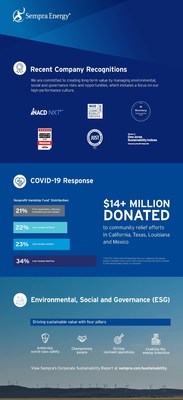
Earlier this year, the company released its 12th annual corporate sustainability report and has continued to drive sustainability at its U.S. utilities with the announcement of multiple projects designed to further clean transportation technologies and advance carbon neutrality in its energy delivery. The Sempra Energy Foundation and Sempra Energy family of companies have also invested more than $18.5 million in 2020 toward COVID-19 response, social justice causes and natural disaster aid across its areas of operation in California, Texas, Louisiana and Mexico.

About Sempra Energy
Sempra Energy’s mission is to be North America’s premier energy infrastructure company. With more than $60 billion in total assets at the end of 2019, the San Diego-based company is the utility holding company with the largest U.S. customer base. The Sempra Energy companies’ more than 18,000 employees deliver energy with purpose to over 35 million consumers. The company is focused on the most attractive markets in North America, including California, Texas, Mexico and the LNG export market. Sempra Energy has been consistently recognized for its leadership in sustainability, and diversity and inclusion, and is a member of the S&P 500 Utilities Index and the Dow Jones Utility Index. The company was also named one of the “World’s Most Admired Companies” for 2020 by Fortune Magazine.


Cision View original content to download multimedia:http://www.prnewswire.com/news-releases/sempra-energy-named-to-dow-jones-sustainability-world-index-for-third-consecutive-year-301176675.html

SOURCE Sempra Energy

Macy’s, Inc. Reports Third Quarter 2020 Results

Macy’s, Inc. Reports Third Quarter 2020 Results

NEW YORK–(BUSINESS WIRE)–
Macy’s, Inc. (NYSE: M) today reported results for the third quarter of 2020.

“Macy’s, Inc. third quarter results reflect solid performance across all three brands – Macy’s, Bloomingdale’s and Bluemercury. Our results were driven by disciplined cost management, strong execution by our colleagues and an early start to the holiday shopping season,” said Jeff Gennette, chairman and chief executive officer of Macy’s, Inc. “Customers shopped our brands across all channels in the third quarter and responded well to our expanded fulfillment offerings, such as curbside, store pickup and same-day delivery. Our digital business delivered strong growth and sales in our stores continued to recover. Customers have shifted their spending to casual apparel and categories they can enjoy as they stay at home. Several of these categories, including home furnishings, jewelry and fragrance, have generated double-digit sales growth compared to last year.”

“Looking to Holiday 2020, we know this year is different. We are committed to bringing the joy of the season to America as we do every year. From next week’s Thanksgiving Day Parade to reimagined family gatherings, we will help our customers and their families celebrate in style. We have the right gifting assortment with newness from value to luxury, and our expanded fulfillment options allow customers to shop safely and conveniently, in store or online,” continued Gennette. “We continue to watch the resurgence of COVID-19 and its potential impact on our business. Our teams are executing well and have shown the flexibility and agility to adjust plans and provide a great omnichannel experience to our customers.”

Financial Highlights


Third Quarter

Year to Date

(All amounts in millions, except per share figures)

2020

2019

2020

2019

Net sales

$

3,990


$

5,173

$

10,566


$

16,223


Net income (loss) (a) (b)

$

(91

)

$

2

$

(4,104

)

$

224

Earnings (loss) before interest, taxes, depreciation and amortization (a) (b)

$

113


$

300

$

(4,182

)

$

1,147

Diluted earnings (loss) per share (a) (b)

$

(0.29

)

$

0.01

$

(13.20

)

$

0.72


Adjusted Net income (loss) (b)

$

(60

)

$

21

$

(941

)

$

246

Adjusted Earnings (loss) before interest, taxes, depreciation and amortization (b)

$

159


$

325

$

(672

)

$

1,175

Adjusted Diluted earnings (loss) per share (b)

$

(0.19

)

$

0.07

$

(3.03

)

$

0.79

(a): The results for the 39 weeks ended October 31, 2020 include the pre-tax impact of the non-cash goodwill and long-lived asset impairment charges of $3.1 billion and $83 million, respectively, as well as the related tax impact.

(b): The results for the 13 and 39 weeks ended October 31, 2020 include benefits of tax law changes resulting from the Coronavirus Aid, Relief and Economic Security (“CARES”) Act.

Note: Adjusted metrics reflect the exclusion of certain items from the respective financial measures. Please see the final pages of this news release for important information regarding the nature of such excluded amounts and calculation of the company’s non-GAAP financial measures.

Third Quarter Highlights

  • Positive EBITDA one quarter sooner than expected.
  • Strong liquidity position with approximately $1.6 billion in cash and approximately $3 billion of untapped capacity in the company’s asset-based credit facility.
  • Digital sales grew 27% over third quarter 2019. Digital sales penetrated at 38% of total owned comparable sales.
  • Comparable sales down 21.0% on an owned basis and down 20.2% on an owned plus licensed basis, due to continued stores recovery and continued growth of digital business.
  • Inventory down 29% from third quarter 2019. The company exited the quarter in a clean inventory position.
  • Gross margin of 35.6% compared to 23.6% in the second quarter of 2020, an improvement of approximately 12 percentage points. The improvement was driven by disciplined inventory management, better sell through of both full-price and clearance merchandise and lower clearance markdowns.
  • Selling, general and administrative (“SG&A”) expense of $1.7 billion, down $476 million from third quarter 2019, illustrating efficient expense management and improved colleague productivity in stores.
  • Diluted loss per share of $(0.29) and Adjusted diluted loss per share of $(0.19).

2020 Guidance

Macy’s, Inc. previously withdrew its 2020 earnings guidance due to ongoing uncertainty as a result of the COVID-19 pandemic. The company is providing limited guidance for 2020, which can be found on the company’s website at www.macysinc.com

Conference Call and Webcasts

A webcast of Macy’s, Inc.’s call with analysts and investors to report its third quarter 2020 sales and earnings will be held today (November 19, 2020) at 8:00 a.m. ET. Macy’s, Inc.’s webcast, along with the associated presentation, is accessible to the media and general public via the company’s website at www.macysinc.com. Analysts and investors may call in on 1-888-394-8218 passcode 9984154. A replay of the conference call and slides can be accessed on the website or by calling 1-888-203-1112 (same passcode) about two hours after the conclusion of the call. Additional information on Macy’s, Inc., including past news releases, is available at www.macysinc.com/pressroom.

Macy’s, Inc. is scheduled to present at the Morgan Stanley Virtual Global Consumer & Retail Conference at 8:00 a.m. ET on Tuesday, December 1, 2020. Media and investors may access a live audio webcast of the presentation at www.macysinc.com on December 1, 2020. A replay of the webcast will be available on the company’s website.

Important Information Regarding Financial Measures

Please see the final pages of this news release for important information regarding the calculation of the company’s non-GAAP financial measures.

About Macy’s, Inc.

Macy’s, Inc. (NYSE: M) is one of the nation’s premier omni-channel fashion retailers. The company comprises three retail brands, Macy’s, Bloomingdale’s and Bluemercury. Macy’s, Inc. is headquartered in New York, New York. For more information, please visit www.macysinc.com.

Forward-Looking Statements

All statements in this press release that are not statements of historical fact are forward-looking statements within the meaning of the Private Securities Litigation Reform Act of 1995. Such statements are based upon the current beliefs and expectations of Macy’s management and are subject to significant risks and uncertainties. Actual results could differ materially from those expressed in or implied by the forward-looking statements contained in this release because of a variety of factors, including the effects of the novel coronavirus (COVID-19) on Macy’s customer demand and supply chain, as well as its consolidated results of operation, financial position and cash flows, Macy’s ability to successfully implement its Polaris strategy and restructuring, including the ability to realize the anticipated benefits within the expected time frame or at all, conditions to, or changes in the timing of proposed real estate and other transactions, prevailing interest rates and non-recurring charges, the effect of potential changes to trade policies, store closings, competitive pressures from specialty stores, general merchandise stores, off-price and discount stores, manufacturers’ outlets, the Internet and catalogs and general consumer spending levels, including the impact of the availability and level of consumer debt, possible systems failures and/or security breaches, the potential for the incurrence of charges in connection with the impairment of intangible assets, including goodwill, Macy’s reliance on foreign sources of production, including risks related to the disruption of imports by labor disputes, regional or global health pandemics, and regional political and economic conditions, the effect of weather and other factors identified in documents filed by the company with the Securities and Exchange Commission, including under the captions “Forward-Looking Statements” and “Risk Factors” in the Company’s Annual Report on Form 10-K for the year ended February 1, 2020 and Quarterly Report on Form 10-Q for the quarterly period ended August 1, 2020. Macy’s disclaims any intention or obligation to update or revise any forward-looking statements, whether as a result of new information, future events or otherwise, except as required by law.

MACY’S, INC.

Consolidated Statements of Operations (Unaudited) (Note 1)

(All amounts in millions except percentages and per share figures)


13 Weeks Ended


13 Weeks Ended


October 31, 2020


November 2, 2019


$


% to

Net sales


$


% to

Net sales


Net sales


$

3,990


$

5,173


Credit card revenues, net


195


4.9

%


183


3.5

%


Cost of sales


(2,569

)


(64.4

%)


(3,106

)


(60.0

%)


Selling, general and administrative expenses


(1,726

)


(43.3

%)


(2,202

)


(42.6

%)


Gains on sale of real estate


3


0.1

%


17


0.3

%


Restructuring, impairment and other costs


(20

)


(0.5

%)


(13

)


(0.2

%)


Operating income (loss)


(127

)


(3.2

%)


52


1.0

%


Benefit plan income, net


16


8


Settlement charges


(26

)


(12

)


Interest expense, net


(80

)


(48

)


Income (loss) before income taxes


(217

)


Federal, state and local income tax benefit (Note 3)


126


2


Net income (loss)


$

(91

)


$

2


Basic earnings (loss) per share


$

(0.29

)


$

0.01


Diluted earnings (loss) per share


$

(0.29

)


$

0.01


Average common shares:


Basic


311.2


309.9


Diluted


311.2


311.0


End of period common shares outstanding


310.3


309.0


Supplemental Financial Measures:


Gross Margin (Note 4)


$

1,421


35.6

%


$

2,067


40.0

%

Depreciation and amortization expense


$

250


$

252


MACY’S, INC.

Consolidated Statements of Operations (Unaudited) (Note 1)

(All amounts in millions except percentages and per share figures)


39 Weeks Ended


39 Weeks Ended


October 31, 2020


November 2, 2019


$


% to

Net sales


$


% to

Net sales


Net sales


$

10,566


$

16,223


Credit card revenues, net


494


4.7

%


531


3.3

%


Cost of sales


(7,788

)


(73.7

%)


(9,905

)


(61.1

%)


Selling, general and administrative expenses


(4,723

)


(44.7

%)


(6,489

)


(40.0

%)


Gains on sale of real estate


20


0.2

%


67


0.4

%


Impairment, restructuring and other costs (Note 2)


(3,445

)


(32.6

%)


(16

)


(0.1

%)


Operating income (loss)


(4,876

)


(46.1

%)


411


2.5

%


Benefit plan income, net


37


23


Settlement charges


(65

)


(12

)


Interest expense, net


(196

)


(143

)


Financing costs


(4

)


Income (loss) before income taxes


(5,104

)


279


Federal, state and local income tax benefit (expense) (Note 3)


1,000


(55

)


Net income (loss)


$

(4,104

)


$

224


Basic earnings (loss) per share


$

(13.20

)


$

0.72


Diluted earnings (loss) per share


$

(13.20

)


$

0.72


Average common shares:


Basic


311.0


309.6


Diluted


311.0


311.3


End of period common shares outstanding


310.3


309.0


Supplemental Financial Measures:


Gross Margin (Note 4)


$

2,778


26.3

%


$

6,318


38.9

%

Depreciation and amortization expense


$

722


$

725


MACY’S, INC.

Consolidated Balance Sheets (Unaudited) (Note 1)

(millions)


October 31, 2020


February 1, 2020


November 2, 2019

ASSETS:


Current Assets:


Cash and cash equivalents


$

1,551


$

685


$

301

Receivables


185


409


175

Merchandise inventories


5,144


5,188


7,256

Prepaid expenses and other current assets


477


528


569

Total Current Assets


7,357


6,810


8,301


Property and Equipment – net


6,122


6,633


6,558

Right of Use Assets


3,028


2,668


2,596

Goodwill


828


3,908


3,908

Other Intangible Assets – net


437


439


440

Other Assets


1,442


714


744


Total Assets


$

19,214


$

21,172


$

22,547


LIABILITIES AND SHAREHOLDERS’ EQUITY:


Current Liabilities:


Short-term debt


$

536


$

539


$

6

Merchandise accounts payable


3,267


1,682


3,427

Accounts payable and accrued liabilities


2,848


3,448


3,046

Income taxes


81


Total Current Liabilities


6,651


5,750


6,479


Long-Term Debt


4,852


3,621


4,677

Long-Term Lease Liabilities


3,266


2,918


2,819

Deferred Income Taxes


917


1,169


1,200

Other Liabilities


1,285


1,337


1,315

Shareholders’ Equity


2,243


6,377


6,057


Total Liabilities and Shareholders’ Equity


$

19,214


$

21,172


$

22,547

MACY’S, INC.

Consolidated Statements of Cash Flows (Unaudited) (Notes 1 and 5)

(millions)


39 Weeks Ended


39 Weeks Ended


October 31, 2020


November 2, 2019

Cash flows from operating activities:


Net income (loss)


$

(4,104

)


$

224


Adjustments to reconcile net income (loss) to net cash provided (used) by operating activities:


Impairment, restructuring and other costs


3,445


16


Settlement charges


65


12


Depreciation and amortization


722


725


Benefit plans


36


23


Stock-based compensation expense


21


40


Gains on sale of real estate


(20

)


(67

)

Deferred income taxes


(270

)


25


Amortization of financing costs and premium on acquired debt


11


1


Changes in assets and liabilities:


Decrease in receivables


223


224


(Increase) decrease in merchandise inventories


34


(1,993

)

Decrease in prepaid expenses and other current assets


29


13


Increase in merchandise accounts payable


1,612


1,648


Decrease in accounts payable and accrued liabilities


(598

)


(470

)

Decrease in current income taxes


(818

)


(168

)

Change in other assets and liabilities


(144

)


(81

)

Net cash provided by operating activities


244


172


Cash flows from investing activities:


Purchase of property and equipment


(290

)


(623

)

Capitalized software


(96

)


(189

)

Disposition of property and equipment


39


73


Other, net


33


10


Net cash used by investing activities


(314

)


(729

)


Cash flows from financing activities:


Debt issued


2,780


Debt issuance costs


(102

)


(3

)

Debt repaid


(1,508

)


(42

)

Dividends paid


(117

)


(349

)

Increase (decrease) in outstanding checks


(90

)


49


Acquisition of treasury stock


(1

)

Issuance of common stock


6


Net cash provided (used) by financing activities


963


(340

)


Net increase (decrease) in cash, cash equivalents and restricted cash


893


(897

)

Cash, cash equivalents and restricted cash beginning of period


731


1,248


Cash, cash equivalents and restricted cash end of period


$

1,624


$

351


MACY’S, INC.

Consolidated Financial Statements (Unaudited)

Notes:


(1)

As a result of the seasonal nature of the retail business, the results of operations for the 13 and 39 weeks ended October 31, 2020 and November 2, 2019 are not necessarily indicative of such results for the fiscal year. Certain reclassifications were made to the prior period’s amounts to conform with the classifications of such amounts in the most recent period.


(2)

The 39 weeks ended October 31, 2020 also include non-cash impairment charges totaling $3.2 billion, which consist of a $3.1 billion goodwill impairment charge and an $83 million impairment charge on long-lived tangible and right of use assets.


(3)

The income tax benefits of $126 million and $1.0 billion, or 58.1% and 19.6% of pretax loss, for the 13 and 39 weeks ended October 31, 2020 reflect a different projected benefit rate as compared to the company’s federal income tax statutory rate of 21% due to the carryback of net operating losses as permitted under the CARES Act. For the 39 weeks ended October 31, 2020, the benefit of the available carryback of net operating losses was offset by the impact of the non-tax deductible component of the goodwill impairment charge and additional income tax expense associated with the deferred tax remeasurement recognized during the first quarter of 2020.


(4)

Gross margin is defined as net sales less cost of sales.


(5)

Restricted cash of $73 million and $50 million have been included with cash and cash equivalents for the 39 weeks ended October 31, 2020 and November 2, 2019, respectively.

MACY’S, INC.

Important Information Regarding Non-GAAP Financial Measures

The company reports its financial results in accordance with U.S. generally accepted accounting principles (GAAP). However, management believes that certain non-GAAP financial measures provide users of the company’s financial information with additional useful information in evaluating operating performance. Management believes that providing supplemental changes in comparable sales on an owned plus licensed basis and changes in comparable sales on an owned plus licensed basis, which includes adjusting for growth in comparable sales of departments licensed to third parties, assists in evaluating the company’s ability to generate sales growth, whether through owned businesses or departments licensed to third parties, and in evaluating the impact of changes in the manner in which certain departments are operated. Earnings (loss) before interest, taxes, depreciation and amortization (EBITDA) is a non-GAAP financial measure which the company believes provides meaningful information about its operational efficiency by excluding the impact of changes in tax law and structure, debt levels and capital investment. In addition, management believes that excluding certain items from EBITDA, net income (loss) and diluted earnings (loss) per share that are not associated with the company’s core operations and that may vary substantially in frequency and magnitude from period-to-period provides useful supplemental measures that assist in evaluating the company’s ability to generate earnings and to more readily compare these metrics between past and future periods.

Non-GAAP financial measures should be viewed as supplementing, and not as an alternative or substitute for, the company’s financial results prepared in accordance with GAAP. Certain of the items that may be excluded or included in non-GAAP financial measures may be significant items that could impact the company’s financial position, results of operations or cash flows and should therefore be considered in assessing the company’s actual and future financial condition and performance. Additionally, the amounts received by the company on account of sales of departments licensed to third parties are limited to commissions received on such sales. The methods used by the company to calculate its non-GAAP financial measures may differ significantly from methods used by other companies to compute similar measures. As a result, any non-GAAP financial measures presented herein may not be comparable to similar measures provided by other companies.

MACY’S, INC.

Important Information Regarding Non-GAAP Financial Measures

(All amounts in millions except percentages and per share figures)


Changes in Comparable Sales


13 Weeks Ended


39 Weeks Ended


October 31, 2020


October 31, 2020


Decrease in comparable sales on an owned basis (Note 6)


(21.0

)%


(33.9

)%

Comparable sales growth impact of departments licensed to third parties (Note 7)


0.8

%


0.1

%

Decrease in comparable sales on an owned plus licensed basis


(20.2

)%


(33.8

)%


13 Weeks Ended


39 Weeks Ended


November 2, 2019


November 2, 2019


Decrease in comparable sales on an owned basis (Note 6)


(3.9

)%


(1.0

)%

Comparable sales growth impact of departments licensed to third parties (Note 7)


0.4

%


0.2

%

Decrease in comparable sales on an owned plus licensed basis


(3.5

)%


(0.8

)%

Notes:


(6)

Represents the period-to-period percentage change in net sales from stores in operation throughout the year presented and the immediately preceding year and all online sales, excluding commissions from departments licensed to third parties. Stores impacted by a natural disaster or undergoing significant expansion or shrinkage remain in the comparable sales calculation unless the store, or material portion of the store, is closed for a significant period of time. No stores have been excluded as a result of the COVID-19 pandemic. Definitions and calculations of comparable sales may differ among companies in the retail industry.


(7)

Represents the impact of including the sales of departments licensed to third parties occurring in stores in operation throughout the year presented and the immediately preceding year and all online sales in the calculation of comparable sales. The company licenses third parties to operate certain departments in its stores and online and receives commissions from these third parties based on a percentage of their net sales. In its financial statements prepared in conformity with GAAP, the company includes these commissions (rather than sales of the departments licensed to third parties) in its net sales. The company does not, however, include any amounts in respect of licensed department sales (or any commissions earned on such sales) in its comparable sales in accordance with GAAP (i.e., on an owned basis). The amounts of commissions earned on sales of departments licensed to third parties are not material to its net sales for the periods presented.

MACY’S, INC.

Important Information Regarding Non-GAAP Financial Measures

(All amounts in millions except percentages and per share figures)

Earnings (Loss) before Interest, Taxes, Depreciation and Amortization, Net Income (Loss) and Diluted Earnings (Loss) Per Share, Excluding Certain Items

Non-GAAP financial measures, excluding certain items below, are reconciled to the most directly comparable GAAP measure as follows:

  • EBITDA and adjusted EBITDA are reconciled to GAAP net income (loss).
  • Adjusted net income (loss) is reconciled to GAAP net income (loss).
  • Adjusted diluted earnings (loss) per share is reconciled to GAAP diluted earnings (loss) per share.

EBITDA and Adjusted EBITDA


13 Weeks Ended


13 Weeks Ended


October 31, 2020


November 2, 2019


Net income (loss)


$

(91

)


$

2


Interest expense, net


80


48


Federal, state and local income tax benefit


(126

)


(2

)

Depreciation and amortization


250


252


EBITDA


113


300


Restructuring, impairment and other costs


20


13


Settlement charges


26


12


Adjusted EBITDA


$

159


$

325


39 Weeks Ended


39 Weeks Ended


October 31, 2020


November 2, 2019


Net income (loss)


$

(4,104

)


$

224

Interest expense, net


196


143

Financing costs


4


Federal, state and local income tax expense (benefit)


(1,000

)


55

Depreciation and amortization


722


725

EBITDA


(4,182

)


1,147

Impairment, restructuring and other costs


3,445


16

Settlement charges


65


12

Adjusted EBITDA


$

(672

)


$

1,175

MACY’S, INC.

Important Information Regarding Non-GAAP Financial Measures

(All amounts in millions except percentages and per share figures)


Adjusted Net Income (Loss) and Adjusted Diluted Earnings (Loss) Per Share


13 Weeks Ended


13 Weeks Ended


October 31, 2020


November 2, 2019


Net Income (Loss)


Diluted Earnings (Loss) Per Share


Net Income


Diluted Earnings Per Share

As reported


$

(91

)


$

(0.29

)


$

2


$

0.01


Restructuring, impairment and other costs


20


0.06


13


0.04


Settlement charges


26


0.09


12


0.04


Income tax impact of certain items identified above


(15

)


(0.05

)


(6

)


(0.02

)

As adjusted


$

(60

)


$

(0.19

)


$

21


$

0.07


39 Weeks Ended


39 Weeks Ended


October 31, 2020


November 2, 2019


Net Income (Loss)


Diluted Earnings (Loss) Per Share


Net Income


Diluted Earnings Per Share

As reported


$

(4,104

)


$

(13.20

)


$

224


$

0.72


Impairment, restructuring and other costs


3,445


11.08


16


0.05


Settlement charges


65


0.21


12


0.04


Financing costs


4


0.01


Income tax impact of certain items identified above


(351

)


(1.13

)


(6

)


(0.02

)

As adjusted


$

(941

)


$

(3.03

)


$

246


$

0.79


Media – Blair Rosenberg

[email protected]

Investors – Mike McGuire

[email protected]

KEYWORDS: New York Ohio United States North America

INDUSTRY KEYWORDS: Fashion Cosmetics Retail Luxury Department Stores Home Goods

MEDIA:

Logo
Logo

New Pacific Identifies High-Grade Gold and Silver Mineralization at Its Silverstrike Project, Bolivia

Continuous Chip Samples Return 4.7 Metres Grading 14.76 Grams per Tonne Gold and 42 Metres Grading 1.02 Grams per Tonne Gold

VANCOUVER, British Columbia, Nov. 19, 2020 (GLOBE NEWSWIRE) — New Pacific Metals Corp. (“New Pacific” or the “Company”) is pleased to provide an update on exploration activities at the Silverstrike Project, Bolivia. Recent field work has focused on the Silverstrike Central and South areas where the Company has identified three significant new zones of gold and silver rich polymetallic mineralization – Table 1 and Figure 1. These areas, together with the previously released Silverstrike North zones, form high priority drill targets for testing once the required permits are obtained (see news release dated September 29, 2020 for details on Silverstrike North discovery).

Table 1

Highlights of
Silverstrike Central and South
Geochemical Assay Results
Area/Zone Sample Type Assay Results Comment
Manco Kapac
Mine dump grab 2.64g/t Au, 1,385g/t Ag, 2.41% Pb, 2.5% Zn & 7.58% Cu Surface mine dump
0.4g/t Au, 1,480g/t Ag, 1.41% Pb & 2.09% Cu
Continuous chip 2.3g/t Au, 164g/t Ag, 2.49% Pb, 0.68% Zn & 0.9% Cu over an average width 1.09m over a strike length of 70m Underground drift
Continuous chip 6.38g/t Au, 239g/t Ag, 3.13% Pb & 0.95% Cu over 1.3m
Continuous chip 6.99g/t Au, 180g/t Ag, 1.78% Pb & 0.65% Cu over 1.4m
Tatitu Kkollu North (TKN)
Mine dump grab 1,380g/t Ag, 2.44% Pb, 0.83% Zn & 2.51% Cu Surface mine dump
Continuous chip 233g/t Ag & 0.56% Pb over a 1mx2m panel Surface outcrop
Continuous chip 309g/t Ag, 0.24% Pb & 1.72% Zn over 0.8m
Tatitu Kkollu South (TKS)
Continuous chip 42m @ 1.02g/t Au, incl. 2.0m @ 10.05g/t Au,
2.0m @ 3.62g/t Au, 56g/t Ag,
2.0m @ 3.73g/t Au, 79g/t Ag
Surface outcrop Channel Chip Site 1
Continuous chip 4.7m @ 14.76g/t Au, incl. 2.0m @ 32.7g/t Au Surface outcrop Channel Chip Site 2
Continuous chip 10.0m @ 1.45g/t Au, incl. 1.0m @ 9.18g/t Au Surface outcrop at Channel Chip Site 3
Silverstrike South
Continuous chip 1.6m @ 255g/t Ag, Surface outcrop

Continuous chip 1.2m @ 197g/t Ag & 1.24% Pb
Continuous chip 1.0m @ 119g/t Ag, 1.17% Pb, 1.62% Zn & 0.27% Cu

Notes:

  1. The highlights are sourced from assay results of 452 samples taken to date.
  2. Grab samples are selective in nature and are not necessarily representative of in situ mineralization.
  3. Channel chip sample interval is close to true width as chip samples were taken across and normal to mineralized structures. Average grade is length weighted.

BACKGROUND

The large Silverstrike property is comprised of three geologically distinct areas termed Silverstrike North, Central and South within which individual target zones occur (see news release dated December 4, 2019 for details). The current exploration program consists of 1:5,000 scale reconnaissance and 1:500 scale detailed geological, structural and alteration mapping and sampling of the Central and South areas. Highlights of assay results from the Central and South areas are provided in Table 1 and discussed below. A total of 452 samples were collected including 441 channel chip samples and 11 mine dump grab samples.

DISCUSSION

Silverstrike Central

Silverstrike Central is dominated by a ~900 metres (m) diameter volcanic dome – Cerro Tatitu Kkollu which consists of volcanoclastic sediments, hydrothermal breccias, rhyolite dyke swarms, and andesite flows (Figure 1).

Three significant areas of structurally controlled mineralization are geologically associated with the volcanic complex: Manco Kapac, Tatitu Kkollu North and Tatitu Kkollu South. Approximately 700m to the north of the dome silver-rich polymetallic mineralization was historically exploited at the former Manco Kapac mine. Centred on and immediately to the north of the dome, field work and previous drilling by Rio Tinto (in 1995) has identified broad zones of gold and silver-rich polymetallic mineralization hosted in hydrothermal breccias at Tatitu Kkollu North. Finally, gold mineralization has been defined at Tatitu Kkollu South at the contact zones between rhyolite dykes and their associated volcanoclastic sedimentary pile. See Table 1 for details.

Note: Drill intercepts are historical. The Company has not verified them as the historical drill cores are not available.

The former Manco Kapac mine is characterized by mine dumps scattered along a NE trending corridor approximately 700m long and up to 200m wide (Figure 1). Exposure is comprised of intermittent outcrops of andesite and pyroclastics covered by recent alluvial sediments.

The distribution of the mine dumps suggest that multiple mineralized vein-breccia zones were mined in the past however, the majority of the former underground workings are not accessible. Mineralization is comprised of silicified vein breccia cemented by disseminated gold and silver rich polymetallic mineralization. Seven dump grab samples were collected returning average grades of 0.58g/t Au, 788g/t Ag, 6.07% Pb, 5.48% Zn, and 2.79% Cu (Table 2). A total of 49 channel chip samples were taken including 21 continuous chip samples from an accessible adit which returned an average grade of 2.3g/t Au, 164g/t Ag, 2.49% Pb, 0.68% Zn, and 0.9% Cu over an average width 1.09m and strike length of 70m (Table 3).

Table –
2
Assay Results from Manco Kapac Mine Dumps

*
Samp_id Au_g/t Ag_g/t Pb_% Zn_% Cu_%
SHC000062 0.36 438 0.86 1.2 4.35
SHC000063 2.64 1,385 2.41 2.5 7.58
SHC000064 0.15 177 0.48 0.28 0.5
SHC000065 0.4 1,480 1.41 0.25 2.09
SHC000066 0.4 810 2.12 0.35 1.015
SHC000067 0.05 946 34.92 33.41 0.87
SHC000071 0.03 280 0.28 0.37 3.13
Average 0.58 788 6.07 5.48 2.79
* Dump samples are selective in nature and not representative of in situ mineralization.

Table –
3
Assay Results of Underground Chip Samples
from the Manco Kapac Mine

*
Samp_id width_m Au_g/t Ag_g/t Pb_% Zn_% Cu_%
SCH003466 0.60 3.08 144 2.34 0.45 0.46
SCH003467 0.70 1.26 200 2.75 1.06 1.10
SCH003468 0.80 0.52 137 1.36 0.90 0.77
SCH003469 0.80 1.37 98 0.44 0.73 0.76
SCH003470 1.30 6.38 239 3.13 0.47 0.95
SCH003471 2.20 0.10 130 0.83 1.24 0.65
SCH003472 1.20 0.59 67 0.28 1.33 0.63
SCH003473 0.90 6.85 78 0.62 0.33 0.38
SCH003474 1.00 2.80 412 12.30 0.45 3.36
SCH003475 0.80 1.80 171 3.27 1.14 1.12
SCH003476 0.60 5.18 187 6.58 0.76 0.26
SCH003477 0.50 5.04 236 8.53 0.44 0.22
SCH003478 0.60 0.67 50 4.39 0.15 0.08
SCH003479 0.50 1.54 154 3.81 0.21 0.25
SCH003480 1.60 2.59 327 4.45 0.66 0.55
SCH003481 1.40 6.99 180 1.78 0.45 0.65
SCH003482 1.40 1.08 170 1.77 0.46 1.35
SCH003483 0.90 2.05 217 2.62 0.93 1.54
SCH003484 1.10 1.19 150 1.04 0.72 2.00
SCH003485 2.40 1.14 91 0.46 0.45 0.66
SCH003486 1.50 0.24 65 0.59 0.39 0.69
Average 1.09 2.30 164 2.49 0.68 0.90
* Continuous chip samples were taken across and normal to mineralized structures and the interval is close to true width. Average grade is length weighted.


Tatitu Kkollu North

is a silver rich zone associated with a NNE trending hydrothermal breccia estimated to be a minimum of 50m wide and 200m long based on the surface expression of the limited outcrop in the area (Figure 1).

A total of 61 samples (2 mine dumps and 59 channel chips) were collected. The two mine dump samples returned values of 1380g/t Ag, 2.44%Pb, 0.83% Zn and 2.51% Cu and 105g/t Ag, 0.69% Pb and 13.25% Zn respectively. Fifty-nine channel chip samples returned an average grade of 38g/t Ag, 0.11% Pb and 0.23% Zn with the highest sample reporting 309g/t Ag, 0.24% Pb and 1.72% Zn over 0.8m.

In general, the results are in line with historical drilling by Rio Tinto which returned 220m @ 45g/t Ag, 0.51% Pb and 0.44% Zn from 13.0m to 233.0m in hole BER-3, including a higher grade sub-interval of 116m @ 66g/t Ag, 0.81% Pb and 0.67% Zn from 13m to 129m downhole.

Gold-rich polymetallic mineralization at Tatitu Kkollu South occurs adjacent to the contact zones between volcanoclastic sediments and a NE trending rhyolite dyke swarm (Figure 1).

A single dump grab sample collected from a historic exploration adit returned 1.66g/t Au, 154g/t Ag, 0.69% Pb, 0.3% Zn, and 7.97% Cu. A total of 277 channel chip samples were collected over three key outcropping areas – Channel Chip Sites 1 to 3. Channel Chip Site 2 returned the best results and remains open for expansion (Figure 1 and Table 4):

Table-4
Chip Sampling at Site 2 of Gold Zone

*
Samp_id Width_m Au_g/t Ag_g/t Pb_% Zn_% Cu_%
SCH002332 2.00 32.70 20 0.79 0.10 0.14
SCH002333 2.00 1.00 22 0.40 0.04 0.06
SCH002334 0.70 2.81 62 0.75 0.21 2.53
average 4.70 14.76 27 0.62 0.09 0.46
* Continuous chip samples were taken across and normal to mineralized structures and the interval is close to true width. Average grade is length weighted.


Continuous mineralization of 42m @ 1.02g/t Au, 18g/t Ag, 0.15% Pb, and 0.11% Zn including 2.0m @ 10.05g/t Au, 30g/t Ag, 0.22% Pb, and 0.11% Zn was returned from Channel Chip Site-1, and 10m @ 1.45g/t, 14g/t Ag, 0.36% Pb including 1.0m @ 9.18g/t Au, 42g/t Ag and 0.74% Pb from Channel Chip Site-3. In addition to the composited intervals, isolated mineralized samples occur between lower grade or barren intervals beyond the continuous mineralized intervals at Channel Chip Sites 1 and 3.

Drilling by Rio Tinto in 1995 tested a small, near surface portion of the target zone returning broad intervals of Au mineralization:

  • BER-02 – 302m @ 0.27 g/t Au within which 42m returned 0.52g/t Au.
  • BRC-04 – 110m @ 0.46 g/t Au within which 22m returned 1.42 g/t Au.
  • BRC-12 – 258m @ 0.19 g/t Au.

Based on the limited previous drilling by Rio Tinto and the latest sample results anomalous gold mineralization is intermittently traceable over an area of 700m long and up to 300m wide. Consequently, the Company interprets the Tatitu Kkollu South zone to represent an attractive near-surface bulk tonnage gold-rich target within which higher grade intervals may occur along strike and/or at depth.

Silverstrike South

At Silverstrike South, significant colonial-era mining dumps of the former Dos Amigos mine define an east-west trending mineralized zone approximately 350m long which is open on either end where it is covered by surface talus. In addition, currently active hydrothermal sinter and associated sediments indicate that the structure has remained active over a geologically prolonged period. The Company interprets this to be indicative of a metalliferous deep seated structural zone.

In detail, mineralization appears to be structurally controlled at the contact between a rhyolitic dome and Tertiary sediments. The width of mineralized system is unknown and the underground workings are not accessible. Twenty-one channel chip samples were collected predominantly from the partially exposed hanging and footwall to the mined structure, returning average grades of 49g/t Ag with the highest up to 255g/t Ag over 1.6m.

Given the extensive surface dumps and associated mining infrastructure including a small smelting house used to produce silver doré, it is possible that the historic Dos Amigo run of mine head-grades were higher than the grades of the recent chip samples.

FUTURE WORK

The Company is continuing to synthesize and fully interpret the data following which it will generate ranked drill targets for initial testing.

Quality Assurance and Quality Control

The grab and chip samples with results released in this news release were shipped in securely sealed bags by New Pacific staff in the Company’s vehicles directly from field to ALS Global in Oruro, Bolivia for preparation, and ALS Global in Lima, Peru for geochemical analysis. All samples are first analyzed by a multi-element ICP package (ALS code ME-MS41) with ore grade over limits for silver, lead and zinc further analyzed using ALS code OG46. Further silver over limits are analyzed by gravimetric analysis (ALS code of GRA21). Gold is analyzed by fire assay with AAS finish (ALS code Au-AA25).

The assay results of the grab and chip samples are used for reconnaissance purpose, hence no certified reference materials and blank materials were inserted to the normal sample sequence in the field. However, internal QAQC results of ALS lab did not show any significant bias of analysis or contamination during sample preparation.

Technical information contained in this news release has been reviewed and approved by Alex Zhang, P. Geo., Vice President of Exploration, who is a Qualified Person for the purposes of NI 43-101.

COMPLETION OF SPIN-OUT

The Company announces the successful completion of its previously announced spin-out of all common shares of Whitehorse Gold Corp. (“Whitehorse Gold”) held by the Company to Company shareholders effective November 18, 2020 by way of a share exchange under a court approved plan of arrangement (the “Arrangement”). More information about Whitehorse Gold and the Arrangement can be found in the Company’s management information circular dated August 27, 2020 and news releases dated July 22, August 26 and November 17, 2020, all of which are available for viewing on the Company’s SEDAR profile at www.sedar.com. Whitehorse Gold has received conditional approval from the TSX Venture Exchange (“TSXV”) for the listing of its common shares thereon.


ABOUT NEW PACIFIC

New Pacific is a Canadian exploration and development company which owns the Silver Sand Project, in the Potosi Department of Bolivia and the Silverstrike Project in Bolivia.

For further information,
please
contact:

New Pacific Metals Corp. 
Gordon Neal 
President 
Phone: (604) 633-1368
Fax: (604) 669-9387
[email protected] 
www.newpacificmetals.com 

CAUTIONARY NOTE REGARDING FORWARD-LOOKING INFORMATION

Certain of the statements and information in this news release constitute “forward-looking statements” within the meaning of the United States Private Securities Litigation Reform Act of 1995 and “forward-looking information” within the meaning of applicable Canadian provincial securities laws. Any statements or information that express or involve discussions with respect to predictions, expectations, beliefs, plans, projections, objectives, assumptions or future events or performance (often, but not always, using words or phrases such as “expects”, “is expected”, “anticipates”, “believes”, “plans”, “projects”, “estimates”, “assumes”, “intends”, “strategies”, “targets”, “goals”, “forecasts”, “objectives”, “budgets”, “schedules”, “potential” or variations thereof or stating that certain actions, events or results “may”, “could”, “would”, “might” or “will” be taken, occur or be achieved, or the negative of any of these terms and similar expressions) are not statements of historical fact and may be forward-looking statements or information.
Such statements include, but are not limited to:
statements regarding anticipated exploration, drilling, development, construction, and other activities or achievements of the Company; timing of receipt of
permits and regulatory approvals, including
final
TSXV approval of the spin-out and the listing of the Whitehorse Gold common shares on the TSXV; and estimates of the Company’s revenues and capital expenditures.

Forward-looking statements or information are subject to a variety of known and unknown risks, uncertainties and other factors that could cause actual events or results to differ from those reflected in the forward-looking statements or information, including, without limitation, risks relating to: global economic and social impact of COVID-19; fluctuating equity prices, bond prices, commodity prices; calculation of resources, reserves and mineralization,
general economic conditions,
foreign exchange risks, interest rate risk, foreign investment risk; loss of key personnel; conflicts of interest; dependence on management
,
uncertainties relating to the availability and costs of financing needed in the future, environmental risks, operations and political conditions, the regulatory environment in Bolivia and Canada,
and
other factors described
under the heading “Risk Factors” in the Company’s Annual Information Form
for
the year ended June 30, 2020 and its other public filings
.

This list is not exhaustive of the factors that may affect any of the Company’s forward-looking statements or information.

The forward-looking statements are necessarily based on a number of estimates, assumptions, beliefs, expectations and opinions of management as of the date of this
news release
that, while considered reasonable by management, are inherently subject to significant business, economic and competitive uncertainties and contingencies. These estimates, assumptions, beliefs, expectations and options include, but are not limited to, those related to the Company’s ability to carry on current and future operations, including: the duration and effects of COVID-19 on our operations and workforce; development and exploration activities; the timing, extent, duration and economic viability of such operations; the accuracy and reliability of estimates, projections, forecasts, studies and assessments; the Company’s ability to meet or achieve estimates, projections and forecasts;
the stabilization of the political climate in Bolivia
;
the availability and cost of inputs; the price and market for outputs; foreign exchange rates; taxation levels; the timely receipt of necessary approvals or permits; the ability to meet current and future obligations; the ability to obtain timely financing on reasonable terms when required; the current and future social, economic and political conditions; and other assumptions and factors generally associated with the mining industry.

Although the forward-looking statements contained in this
news release
are based upon what management believes are reasonable assumptions, there can be no assurance that actual results will be consistent with these forward-looking statements. All forward-looking statements in this
news release
are qualified by these cautionary statements. Accordingly, readers should not place undue reliance on such statements. Other than specifically required by applicable laws, the Company is under no obligation and expressly disclaims any such obligation to update or alter the forward-looking statements whether as a result of new information, future events or otherwise except as may be required by law. These forward-looking statements are made as of the date of this
news release
.

CAUTIONARY NOTE TO US INVESTORS

The disclosure
in this news release
was prepared in accordance with Canadian National Instrument 43-101 (“NI 43-101”)
and the
Canadian Institute of Mining, Metallurgy and Petroleum Standards
(the “CIM Definition Standards”)
incorporated by reference
therein
, which differs significantly from the current requirements of the U.S. Securities and
Exchange Commission (the “SEC”) set out in Industry Guide 7. Accordingly, such disclosure may
not be comparable to similar information made public by companies that report in accordance with
Industry Guide 7.
In particular, this news release may refer to “mineral resources”, “measured
mineral resources”, “indicated mineral resources” or “inferred mineral resources”. While these
categories of mineralization are recognized and required by Canadian securities laws, they are not
recognized by Industry Guide 7 and are not normally permitted to be disclosed in SEC filings by
U.S. companies that are subject to Industry Guide 7. U.S. investors are cautioned not to assume
that any part of a “mineral resource”, “measured mineral resource”, “indicated mineral resource”,
or “inferred mineral resource” will ever be converted into a “reserve.” In addition, “reserves”
reported by the Company under Canadian standards may not qualify as reserves under Industry
Guide 7. Under Industry Guide 7, mineralization may not be classified as a “reserve” unless the
mineralization can be economically and legally extracted or produced at the time the “reserve”
determination is made. Accordingly, information contained or referenced in this news release
containing descriptions of mineral deposits may not be comparable to similar information made
public by U.S. companies subject to
the United States federal securities laws and the rules and regulations thereunder
.
“Inferred mineral resources” are that part of a mineral resource for which quantity and grade or quality are estimated on the basis of limited geological evidence and sampling. Such geological
evidence is sufficient to imply but not verify geological and grade or quality continuity. However, it is reasonably expected that the majority of inferred mineral resources could be upgraded to indicated mineral resources with continued exploration.
Readers
are cautioned not to assume that all or any part of an inferred mineral resource is economically or legally mineable.
Further, while NI 43-101
permits companies to disclose economic projections contained in preliminary economic
assessments and pre-feasibility studies, which are not based on “reserves”, U.S. companies have
not generally been permitted under Industry Guide 7 to disclose economic projections for a mineral
property in their SEC filings prior to the establishment of “reserves”. Disclosure of “contained
ounces” in a resource is permitted disclosure under Canadian reporting standards; however,
Industry Guide 7 normally only permits issuers to report mineralization that does not constitute
“reserves” by Industry Guide 7 standards as in-place tonnage and grade without reference to unit
measures. Historical results or feasibility models presented herein are not guarantees or
expectations of future performance.

The SEC adopted new mining disclosure rules under subpart 1300 of Regulation S-K of the U.S. Securities Act (the “
SEC
Modernization Rules”) effective February 25, 2019, with compliance required for the first fiscal year beginning on or after January 1, 2021. The SEC Modernization Rules replace the historical property disclosure requirements included in SEC Industry Guide 7. As a result of the adoption of the SEC Modernization Rules, the SEC now recognizes estimates of “Measured Mineral Resources”, “Indicated Mineral Resources” and “Inferred Mineral Resources”. In addition, the SEC has amended its definitions of “Proven Mineral Reserves” and “Probable Mineral Reserves” to be substantially similar to corresponding definitions under the CIM Definition Standards. During the period leading up to the compliance date of the SEC Modernization Rules, information regarding minimal resources or reserves contained or referenced in this
news release
may not be comparable to similar information made public by companies that report according to U.S. standards. While the
SEC
Modernization Rules are expected to be “substantially similar” to the CIM Definitions standards, readers are cautioned that there are differences between the
SEC
Modernization Rules and the CIM Definitions Standards.

A photo accompanying this announcement is available at https://www.globenewswire.com/NewsRoom/AttachmentNg/1bb9fa05-dad3-47f0-b123-46352912dfaa


Corporations and Government Need More Environmental Science Graduates

Husson University STEM Career Webinar Focused on Career Opportunities in Growing Environmental Science Field

BANGOR, MAINE, Nov. 19, 2020 (GLOBE NEWSWIRE) — As public concerns about global warming, the hazards facing the environment, and population growth increase, so too does the demand for educated and knowledgeable professionals in environmental science. Adding to this demand are corporations who feel they need to act in environmentally responsible ways to satisfy the interests of their customers and stakeholders.

The next decade will see significant growth in this career field. According to the U.S. Bureau of Labor Statistics’ Occupational Outlook Handbook, the employment of environmental scientists and specialists is projected to grow 8% from 2019 to 2029, much faster than the average for all occupations.1

In an effort to help Husson students better understand the career opportunities available to them in environmental science; the University hosted a STEM Career Webinar on Tuesday, November 10, 2020 at 4 p.m. The Zoom event featured a panel of three prominent environmental science professionals.

Samuel Kunz, assistant director of career services feels that events like this are essential for any student planning to enter today’s job market. “Students who attended this event had the opportunity to connect with alumni who were once just like they were – undergraduate students at Husson University,” said Kunz. “By the end of the event, our students realized that they too can have successful careers in this field. The only barriers to their success are the ones they make for themselves.”

Events like this offer other benefits as well. Besides learning about what it takes to become successful, students were able to make valuable contacts that can potentially lead to internships or job opportunities after graduation.

The three prominent business professionals who participated in the event’s panel discussion came from a variety of different types of environmental science organizations. They included:

Cara Belanger, a project scientist at Stillwater Environmental Engineering, Inc. (SEE). This company provides a full range of civil engineering, environmental engineering and regulatory compliance assistance to municipal, industrial, and institutional entities.

Belanger graduated from the University of Vermont with a degree in environmental science and a minor in chemistry. Her undergraduate honors research focused on the impact of road salt on aquatic life in streams. At SEE, Belinger conducts storm water sampling, infrastructure inspections, and site inspections. She also helps to plan education and outreach events and assists with developing compliance plans.

Brandon Delano, a water systems operator at Water Quality & Compliance Services. This company specializes in serving Maine’s private and public, water and wastewater systems.

Delano attended Husson University from 2013-2017 and graduated with a Bachelor’s of Science in environmental science and a minor in biology. In the fall of 2017, Maine Coast Laboratory and Water Quality & Compliance Services of Wiscasset, Maine hired him.

At the laboratory, he assists as an analyst. His job responsibilities include processing/analyzing drinking water and wastewater samples. Outside of the laboratory, he works as a field technician, managing the operations of drinking water and wastewater systems across Maine to keep them in compliance with state/federal regulations. In addition, Delano is also leading the fieldwork on a storm water phosphorus-monitoring project with the Department of Environmental Protection (DEP). He has his state class 2T2D license for the operation of regulated drinking water systems. Delano has also earned the National Radon Proficiency Program (NRPP) certification from the American Association of Radon Scientists and Technologists (AARST). He is currently working toward his Biological I license for the operation of regulated wastewater systems.

Johanna Szillery, a senior project scientist at CES Inc. CES Inc. is an engineering, environmental, and survey-consulting firm. Szillery works in the Bangor Office. She has technical training in botany, wetland science, soil science and water chemistry. Szillery has a Bachelor of Arts from Drew University in New Jersey and a Master of Science in plant, soil and environmental science from the University of Maine. She has held positions in the federal government, the National Park Service and the US Department of Agriculture, as well as in a variety of consulting firms.

In her current role, she is the head of the natural resource division at CES, and oversees project planning, natural resource assessments and permitting. Szillery continues to enjoy the variety of her job, from working in beautiful areas throughout the state of Maine, to developing relationships with clients and regulators, to training and mentoring younger staff.

The event was only open to members of the Husson University community. Students didn’t have to be job hunting to participate. This online event was open to students at all levels who were interested in learning more about career opportunities in environmental science.

Robert Northington, PhD, an assistant professor at Husson University’s College of Science and Humanities felt that this online event offered an important glimpse into the careers of the future. “The world’s population continues to grow. As a species, we need to better understand the natural and physical processes that affect the functioning of our planet, if we are to survive.”

“The demand for individuals with a knowledge of environmental science will only continue to grow,” he said. “I’m proud to be able to help develop the next generation of environmental scientists. Their ability to find creative solutions to our climate problems will save lives.”

For more than 120 years, Husson University has prepared future leaders to handle the challenges of tomorrow through innovative undergraduate and graduate degrees. With a commitment to delivering affordable classroom, online and experiential learning opportunities, Husson University has come to represent superior value in higher education. Our Bangor campus and off-campus satellite education center in Northern Maine both provide advanced knowledge in business; health and education; pharmacy studies; science and humanities; as well as communication. In addition, Husson University has a robust adult learning program. According to a recent analysis of tuition and fees by U.S. News & World Report, Husson University is one of the most affordable private colleges in New England. For more information about educational opportunities that can lead to personal and professional success, visit Husson.edu.


# # #


1 Bureau of Labor Statistics’ Occupational Outlook Handbook, “Environmental Scientists and Specialists,” https://www.bls.gov/ooh/life-physical-and-social-science/environmental-scientists-and-specialists.htm


Attachments


Eric B. Gordon
Husson University
207.649.4647
[email protected]

Comscore Continues Digital Measurement Innovation with New US Patent for Fraudulent Traffic Detection

Technical achievement improves Comscore’s industry-leading invalid traffic detection capabilities for more accurate audience measurement

PR Newswire

RESTON, Va., Nov. 19, 2020 /PRNewswire/ — Comscore (Nasdaq: SCOR), a trusted partner for planning, transacting and evaluating media across platforms, today announced that the US Patent and Trademark Office (USPTO) has granted its patent on “Fraudulent Traffic Detection and Estimation”.

This patent covers Comscore’s process of detecting fraudulent or invalid traffic (IVT) based on known fraudulent traffic in a control group. The technology identifies characteristics from the control group, which are then used to identify IVT in a set of measured traffic, for example views of an online ad, or page visits to a web site. By removing the invalid traffic and adjusting click-through rates, Comscore is able to provide advertisers with more accurate and reliable measurement of the performance of advertising campaigns. Those seeking further information can reference US Pat. No. 10,832,280.

“This latest patent builds on Comscore’s superior IVT detection capabilities and adds to the strength of our industry-leading technology,” said Bill Livek, CEO, Comscore.

In 2016, Comscore was the first company to offer both content and campaign measurement leveraging MRC-accredited sophisticated IVT (“SIVT”) filtration, including Media Metrix Desktop and validated Campaign Essentials™ (vCE®) for desktop and mobile web. Its accreditation was extended to include vCE® in mobile application environments in 2017. The underlying detection capabilities are applied throughout Comscore’s digital product portfolio.

Comscore’s commitment to innovation is underscored by the numerous U.S. patents it has been granted over the last five years, including a recent patent for household viewership aggregation. Comscore has brought substantial privacy-conscious digital and TV product innovation to the market as part of a comprehensive roadmap for delivering superior measurement in a cookieless world. 

About Comscore
Comscore (NASDAQ: SCOR) is a trusted partner for planning, transacting and evaluating media across platforms. With a data footprint that combines digital, linear TV, over-the-top and theatrical viewership intelligence with advanced audience insights, Comscore allows media buyers and sellers to quantify their multiscreen behavior and make business decisions with confidence. A proven leader in measuring digital and TV audiences and advertising at scale, Comscore is the industry’s emerging, third-party source for reliable and comprehensive cross-platform measurement. To learn more, visit www.comscore.com


Cision View original content to download multimedia:http://www.prnewswire.com/news-releases/comscore-continues-digital-measurement-innovation-with-new-us-patent-for-fraudulent-traffic-detection-301176451.html

SOURCE Comscore